DeepSeek founder Liang Wenfeng told a closed investor meeting that the company intends to put artificial general intelligence research ahead of near-term commercial growth and is likely to keep its most capable models open source, according to minutes reported by Yicai on July 23. The document has not been authenticated by DeepSeek or Liang, a caveat that matters because the remarks include detailed claims about funding, computing capacity and the company’s technical roadmap.
The reported comments sharpen the question hanging over China’s best-known AI laboratory: whether a company celebrated for doing more with less can preserve that advantage as frontier development becomes more capital intensive. Liang’s answer, as summarized by Yicai and separately reported by Reuters, was that algorithms are not the largest gap with the United States. Access to computing resources is. That diagnosis places DeepSeek’s open-source posture inside an industrial constraint rather than treating it as a branding decision.
DeepSeek’s reported strategy is to keep its leading models broadly available, concentrate internal resources on AGI research and build much larger computing clusters. The immediate limit is hardware: Liang estimated that Chinese labs remain about 12 to 18 months behind the leading American systems, even though DeepSeek can produce comparable results with roughly one-twentieth of the computing resources. Because the underlying minutes remain unverified, those figures should be read as reported management claims, not audited capacity data.
A research agenda with a hardware bill
Liang reportedly described a sequence of priorities that includes stronger chain-of-thought reasoning, agents able to carry out longer tasks, continual learning and systems that can improve through interaction. Embodied AI also appears on the agenda. Video generation and world models, by contrast, are not central to the near-term plan. The distinction is useful: DeepSeek is presenting itself as a laboratory pursuing general problem-solving ability, not as a company trying to match every consumer feature released by a larger rival.
That focus still demands infrastructure. Yicai reported that DeepSeek controls the equivalent of about 20,000 Nvidia H-series accelerators. Liang said the largest overseas models can have about 800 billion active parameters, while Chinese systems typically operate at tens of billions. Parameter counts are an imperfect comparison because model architectures differ, but the order-of-magnitude gap illustrates why efficiency improvements cannot remove the need for more electricity, networking and high-bandwidth memory.
DeepSeek is working to optimize models for Huawei’s Ascend hardware, the account said. Liang described a “Tile Language” approach intended to reduce the performance penalty of running workloads on domestic chips to about 1% to 2%. Even if that result is reproducible, the bottleneck does not disappear. A cluster must combine thousands of accelerators with fast interconnects, stable software and sufficient power. Huawei’s SuperPod architecture can increase usable scale, but reported capacity limits leave deployment well below the largest American installations.
Open source as distribution and discipline
Keeping flagship models open would distinguish DeepSeek from companies that reserve their most capable systems for paid interfaces. It would also extend a pattern that helped the company gain worldwide attention: developers can examine, adapt and deploy model weights without routing every query through DeepSeek. That creates a large testing community and makes the models attractive to organizations concerned about data residency or recurring API costs.
The approach has trade-offs. Open releases can be copied quickly, while a research-first company still needs to finance expensive training runs. Reuters reported that DeepSeek raised about 50 billion yuan, or $7.4 billion, in its first outside funding round in late May at a pre-money valuation of roughly 367.5 billion yuan. Yicai named Tencent, CATL, NetEase, JD.com, IDG and a state-backed fund among the investors and said Liang contributed 20 billion yuan. None of those transaction details has been publicly confirmed by DeepSeek.
The funding context helps explain why Liang can defer a conventional product push. A heavily capitalized laboratory has more room to release research openly than a smaller startup dependent on subscription revenue. It also raises a governance question: investors accepting a long research horizon need clear milestones for compute deployment, model capability and safety. The tension is similar to the one facing other Asian AI builders, including the questions around model provenance in Moonshot AI’s Kimi K3 dispute and evaluation standards discussed in Meta’s AI governance reset.
The evidence that could change the picture
DeepSeek’s efficiency record is meaningful counterevidence to the idea that only the largest clusters can compete. Better data selection, training methods and inference design can shift the cost curve. Yet efficiency gains often increase total use because lower unit costs create more demand. A model that is cheaper to run may be embedded in more products, producing a larger aggregate requirement for chips and electricity. That rebound effect is why Liang’s emphasis on clusters is consistent with the company’s reputation for frugality.
The other uncertainty is commercial durability. Open weights can produce influence without producing cash. DeepSeek could sell enterprise services, specialized deployments or access to higher-performance infrastructure, but Liang’s reported remarks do not establish a revenue model. Nor do they show how the company will handle misuse, security testing or model updates once powerful systems are distributed. Those are practical obligations, not reasons to dismiss open development.
The next observable test is a release. Developers can compare the next flagship model’s benchmark results, compute requirements, license and performance on domestic hardware with the claims in the meeting account. Procurement disclosures or credible estimates of cluster growth would provide a second test. Until then, the clearest verified event is that two news organizations reported the same central message from an unauthenticated transcript: DeepSeek wants to chase AGI, remain open and spend its new capital on the computing gap.
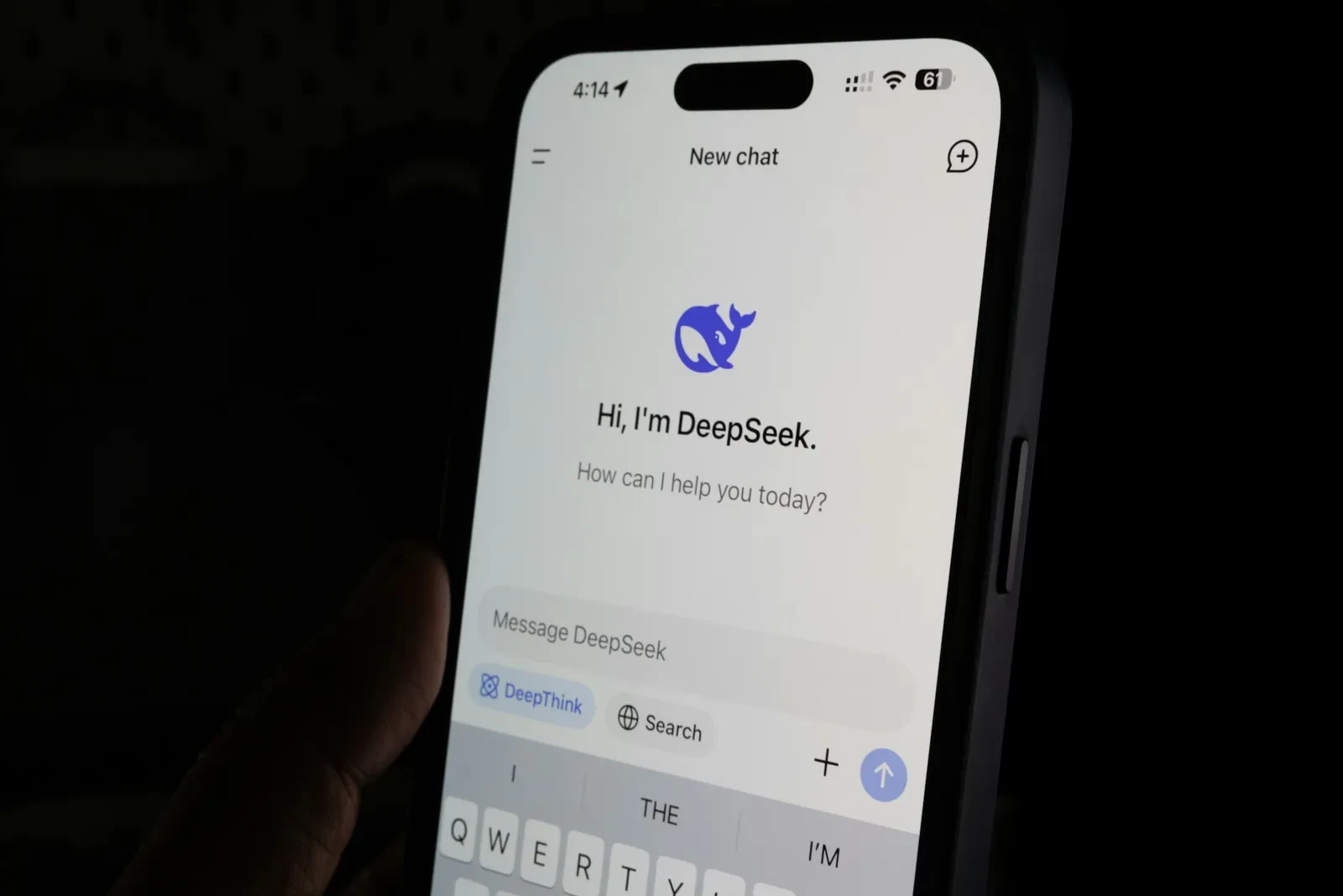
The hero image shows the DeepSeek app in use. Photograph by Solen Feyissa, used under the Unsplash License.