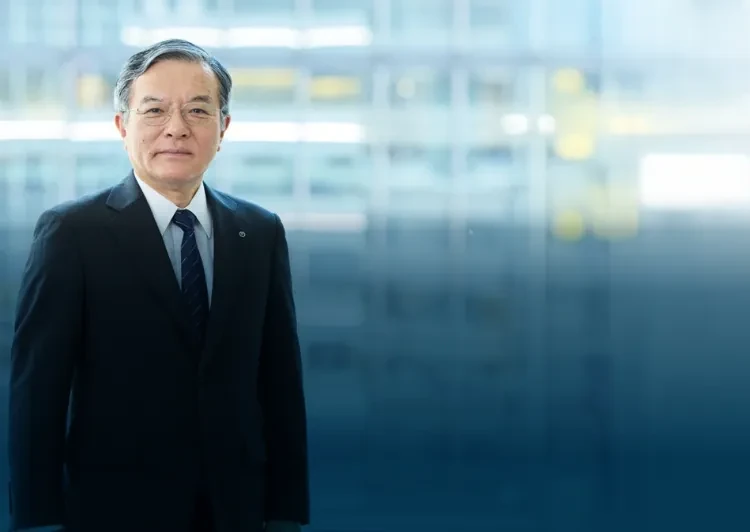
Artificial intelligence is usually discussed as software, but its economic limits are increasingly physical. Models require chips, chips require electricity, and useful services require data to move between users, networks and computing facilities with little delay. Akira Shimada’s NTT sits across that chain. It owns communications infrastructure, serves enterprises, operates data-centre businesses and has spent years developing the photonics-led IOWN architecture. In 2026, that combination has become strategically more relevant and financially more demanding.
NTT finished the year to March 2026 with record operating revenue of ¥14.4091 trillion. EBITDA reached ¥3.4233 trillion and operating profit was ¥1.7062 trillion. For the current year, the group forecasts revenue of ¥15.06 trillion, EBITDA of ¥3.43 trillion and operating profit of ¥1.71 trillion. The outlook describes a company still expanding in scale but expecting little near-term profit growth. That flatness matters. It means Shimada cannot rely on the general growth of cloud and AI infrastructure to guarantee returns; he must improve the productivity and structure of a vast group while funding its next technology cycle.
The core proposition behind IOWN is compelling: shift more information processing and transmission from conventional electronics towards optical technologies, reducing power consumption and latency while increasing capacity. Those advantages correspond directly to the constraints facing AI systems and data centres. Yet technological relevance is not the same as commercial inevitability. NTT must persuade equipment makers, cloud companies, carriers and enterprise customers to adopt standards, invest in compatible systems and share enough value for the group to earn an attractive return.
IOWN must move from destination to product
Large technology visions often remain permanently ahead of the income statement. They generate demonstrations, partnerships and impressive performance claims, but customers buy narrower solutions with defined budgets. Shimada’s challenge is to turn IOWN from an umbrella concept into products that solve immediate problems: lower-power data-centre links, disaggregated computing, deterministic industrial connectivity and infrastructure capable of supporting real-time AI at the edge.
The strongest commercial entry point is energy. Data-centre developers face grid constraints, longer connection queues and political resistance in markets where computing demand competes with households and industry. If NTT can demonstrate that optical networking lowers total power consumption or allows computing resources to be used more efficiently across locations, the benefit has a measurable financial value. The company should price against avoided energy, capacity and delay rather than sell photonics as a superior technical specification.
Latency provides a second path. Autonomous industrial systems, remote operations and some medical or mobility applications cannot depend on distant centralised models alone. They need rapid, predictable communication between sensors, edge computing and larger platforms. NTT’s networks and enterprise relationships give it the ability to design the whole service rather than supply an isolated component. The risk is that integrated projects become bespoke engineering exercises. Repeatable architecture, standard interfaces and clear service levels are necessary if margins are to improve with scale.
Standards are particularly important because NTT cannot create the ecosystem alone. Its 2026 AI fund and collaborations with other telecommunications groups can help align capital and adoption. But strategic investment should not become a substitute for customer evidence. Every partnership needs a route to deployment, interoperability and revenue. Minority investments can accelerate the ecosystem; they can also scatter attention across promising technologies that never reach procurement budgets.
The fund also puts NTT on both sides of the market: it can help finance companies that need advanced connectivity while becoming a supplier, testing partner or distribution channel. That can shorten development cycles, but it creates a risk that strategic affinity weakens investment discipline. Fund returns, procurement decisions and technical certification should remain independently governed. A portfolio company should not receive privileged access to operating budgets merely because NTT owns a stake. Conversely, NTT business units should not be compelled to adopt immature technology to validate an investment thesis. The best outcome is a transparent proving ground in which successful companies win external customers and NTT gains practical insight into emerging workloads. Shimada should disclose enough about deployment and commercial adoption to show that the fund expands the market rather than simply moving capital around the ecosystem.
The group’s scale must become an advantage, not a tax
NTT’s structure spans domestic mobile, regional communications, global solutions, data centres, real estate and energy. This breadth gives Shimada a live environment in which to deploy new technology. It also creates overlapping capital demands and complex accountability. The integrated ICT business alone carries the burden of network quality, customer acquisition and competitive pricing. Global solutions must grow while managing the economics of labour-intensive services and infrastructure. Regional fixed networks face mature demand.
For the year to March 2027, NTT expects integrated ICT operating profit to remain broadly flat and global solutions profit to decline, even as group revenue rises. That pattern reinforces the need for productivity. AI should first improve NTT’s own operations: network maintenance, customer support, software development, energy management and fraud prevention. Internal deployment can establish evidence, lower cost and reveal operational weaknesses before the group sells similar capabilities to clients.
Shimada must be demanding about whether central initiatives reduce duplication. A group of NTT’s size can easily fund multiple model platforms, data tools and innovation teams that address similar problems. Common infrastructure and governance should create economies of scale, while operating companies retain responsibility for customer results. The goal is not centralisation for its own sake. It is to ensure that technical assets are reused and that a successful application in one unit can travel across the group without a new procurement and integration cycle.
Data centres illustrate both the opportunity and the allocation problem. They are valuable infrastructure in an AI-driven market, but they consume heavy capital and can attract lower returns if capacity is built ahead of power, connectivity or contracted demand. NTT has used asset transactions, including data-centre monetisation structures, to recycle capital. Shimada needs a consistent framework for deciding what the group should own, operate, place into investment vehicles or access through partnership. Ownership should follow strategic control and return requirements, not a general belief that all digital infrastructure is scarce.
Nature and resilience belong in the investment case
NTT’s 2026 emphasis on a nature-positive business vision may appear separate from AI infrastructure. In reality, energy, water, land and supply chains are becoming constraints on digital growth. Data centres need cooling and reliable power; networks require materials and physical routes; extreme weather threatens continuity. Environmental performance therefore affects permissions, insurance, financing and customer selection as well as reputation.
Shimada can make sustainability more credible by connecting it to operating metrics. Lower energy per unit of data, improved equipment life, more renewable power and resilient network design all have financial effects. Photonics has a particularly useful role because reduced consumption supports both capacity growth and emissions goals. But NTT should distinguish verified system-level savings from laboratory efficiency. Customers and investors need to know whether the entire service consumes less energy after additional computing, redundancy and cooling are included.
Japan’s exposure to natural disasters also gives NTT a demanding test environment for resilient infrastructure. Distributed computing and flexible network routing can reduce dependence on single sites. Satellite links and partnerships can extend coverage where terrestrial networks are disrupted. These capabilities have social value, but their commercial model needs clarity. Some resilience should be treated as a regulated or public obligation, some as a premium enterprise service and some as a basic requirement for retaining customers.
Capital discipline will decide the legacy
The fiscal 2026 forecast is a useful reality check. Revenue is expected to increase by ¥650.9 billion, yet operating profit by only ¥3.8 billion and attributable profit is forecast to fall. Some of that reflects investment and portfolio effects, but investors will eventually require growth to reach the bottom line. The strongest answer is not a broad promise of medium-term improvement. It is a bridge showing how network investment, AI services, data-centre strategy and cost transformation change cash returns.
NTT also continues to return capital through repurchases, which imposes a productive tension. Cash used for strategic infrastructure must offer better long-term value than buying back shares or reducing financial risk. Shimada should welcome that comparison. It forces projects to compete for funding and prevents technological prestige from becoming an unlimited claim on the balance sheet.
His leadership opportunity is unusual. Few chief executives can influence both the intelligence being deployed and the physical system that makes it affordable. NTT can help move AI from concentrated, energy-intensive computing towards a more distributed optical architecture. It can also use AI to improve one of the world’s largest communications groups. The two directions reinforce each other if internal operating evidence leads to external products.
The danger is equally clear. NTT could spend heavily across photonics, models, funds and facilities while mature businesses absorb rising costs and profit remains flat. Avoiding that outcome requires milestones based on adoption, utilisation, power savings and return on invested capital. In 2026, Shimada no longer needs to prove that AI will strain today’s infrastructure. The market can see the strain. He needs to prove that NTT’s answer can become a disciplined business before the constraint becomes an excuse for undisciplined spending.