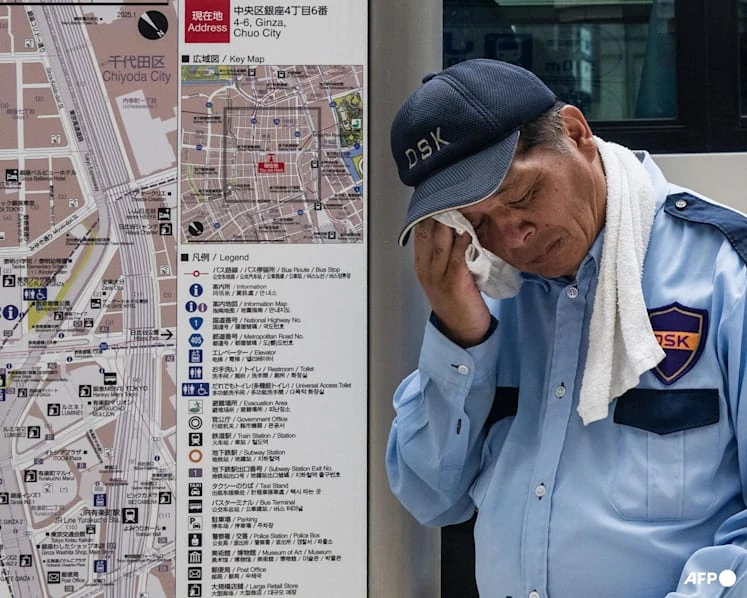
Japan recorded its fifth consecutive “cruelly hot day” on Saturday, July 25, extending the country’s longest run above a newly defined 40°C extreme-heat threshold since comparable records began in 2010.
Six cities in central Japan, including locations in Aichi and Gifu prefectures, exceeded the threshold, according to the Japan Meteorological Agency. Officials also issued heatstroke warnings in parts of the country.
The agency introduced the term kokushobi, translated as “cruelly hot day,” in April to communicate the danger of temperatures above 40°C more clearly. The designation is intended to sharpen public vigilance but does not automatically activate nationwide emergency measures.
Emergency cases reveal the scale
Nearly 11,000 people sought emergency medical care for heat-related conditions between July 13 and 19, according to Japan’s Fire and Disaster Management Agency. Fourteen were pronounced dead on arrival.
Tokyo recorded 453 heat-related hospital cases on Thursday alone, the highest daily total in data stretching back more than a decade. Japan experiences roughly 1,300 heat-related deaths in an average year and has set a goal of cutting that number by half by 2030.
A hotter baseline
The five-day streak follows Japan’s hottest summer on record in 2025. The country’s all-time high of 41.8°C was recorded in Isesaki, north of Tokyo, on August 5 last year.
Scientists have repeatedly linked human-driven climate change to more frequent and intense extreme-heat events. For Japan, the new terminology is one part of a wider challenge that also involves public-health capacity, urban cooling, workplace practices and protections for older residents.
Source note: Japan Meteorological Agency and Fire and Disaster Management Agency data, as reported by AFP and CNA.