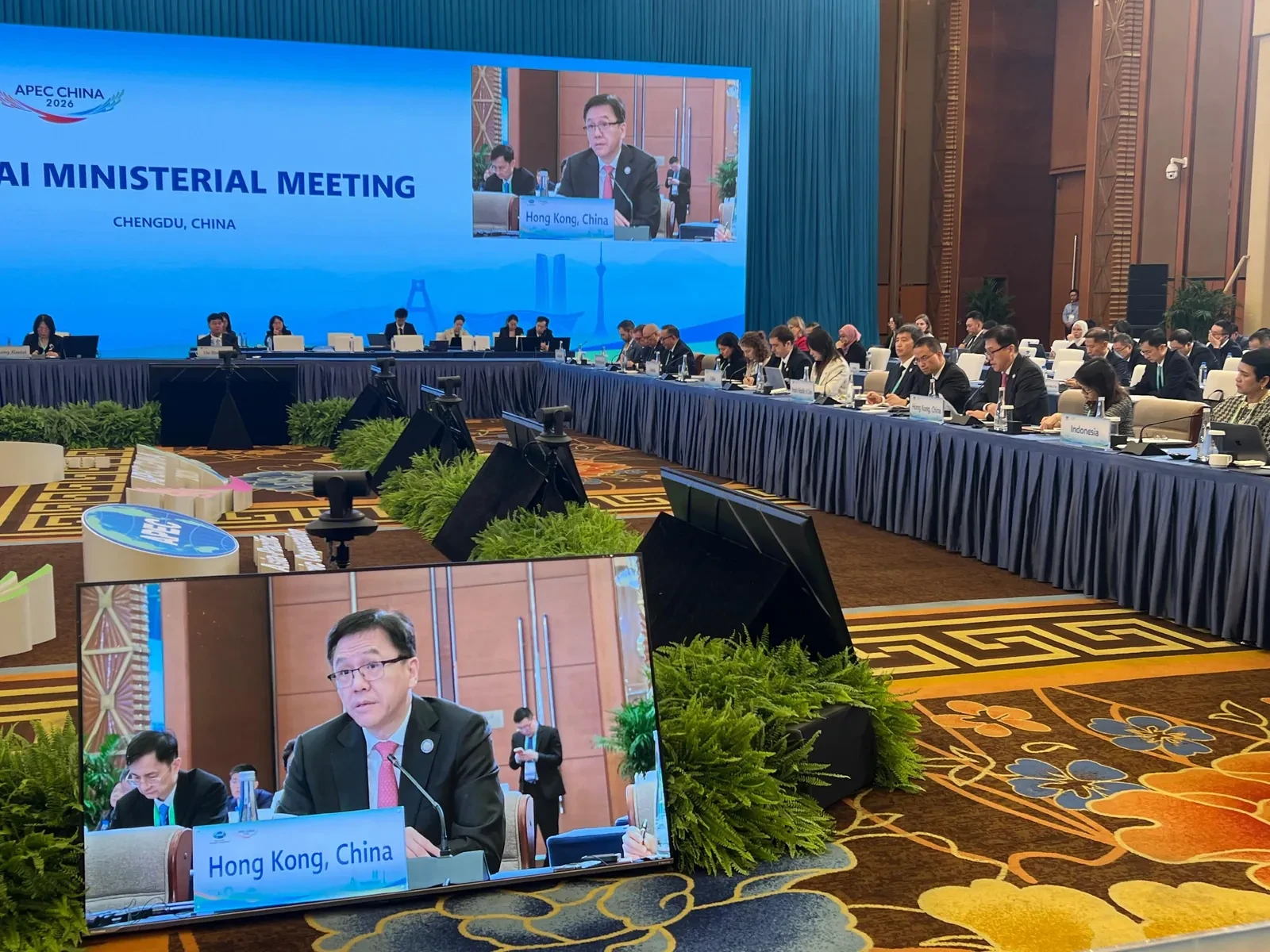
Digital and artificial-intelligence ministers from the Asia-Pacific Economic Cooperation forum adopted a joint statement in Chengdu on July 23, committing their 21 economies to cooperate on infrastructure, open-source innovation, digital skills and adoption by smaller businesses. China’s industry minister Li Lecheng chaired the meeting, the first major implementation checkpoint for APEC’s AI Initiative for 2026–2030.
The statement is a consensus document, not a treaty. It does not set enforceable safety thresholds, cross-border data rules or spending obligations. Its significance lies in the areas where economies with sharply different regulatory systems could agree—and in the projects they now choose to fund.
The Chengdu statement gives APEC a shared AI work program rather than a common rulebook. Ministers endorsed investment in communications and computing infrastructure, secure open-source collaboration, interoperable approaches, workforce skills and tools for micro, small and medium-sized enterprises. Delivery will be measured through named projects, participating economies, budgets and adoption, because the text creates no enforcement mechanism.
Infrastructure comes before aspiration
Ministers encouraged investment in connectivity and computing capacity and called for financing that can reach startups and smaller companies. That pairing recognizes a structural problem: AI capability is increasingly concentrated in organizations able to buy accelerators, power and data-center capacity. A small manufacturer cannot benefit from a model it cannot afford to run or connect to its systems.
The statement supports lightweight digital tools and practical transformation of traditional industries. Li said the group discussed ways for smaller companies to improve competitiveness without building frontier models themselves. APEC’s value is potentially strongest here, where economies can share deployment patterns, technical assistance and procurement lessons rather than debate who leads benchmark tables.
Open source is another area of qualified agreement. The document encourages collaboration while acknowledging security, data and intellectual-property concerns. Those qualifications are not incidental. Open models can reduce costs and allow local adaptation, but they can also be misused or released without adequate documentation. Member economies do not share one definition of acceptable risk.
Interoperability without uniformity
APEC works through voluntary cooperation. That flexibility allows the United States, China, Japan, South Korea, Southeast Asian economies and others to sit inside one process despite different laws. It also limits the forum’s ability to resolve disputes over data localization, model accountability or semiconductor controls.
Interoperability is therefore a more realistic goal than harmonization. Economies can make identity, payments, certification or data-transfer systems work together without adopting identical statutes. The statement calls for compatible approaches and trustworthy digital systems, but technical standards and regulator-to-regulator arrangements will determine whether businesses experience less friction.
Hong Kong’s Secretary for Innovation, Technology and Industry Sun Dong told the meeting that the city planned AI tools for 100 public-administration procedures by the end of 2026 and at least 200 by the end of 2027. That is the kind of measurable commitment the regional statement lacks. Other economies can compare outcomes such as processing time, accuracy, accessibility and public complaints rather than simply count deployments.
A regional contest over access and rules
The meeting took place amid widening competition over chips, cloud capacity and model distribution. Open-source claims have become part of that contest, as shown by InfluenceAsia’s coverage of the provenance dispute around Moonshot AI’s Kimi K3. Governance choices also affect organizational power, a theme in Meta’s changes to AI evaluation.
Skills policy is the bridge between infrastructure and use. Ministers supported broader digital capability and participation by groups at risk of exclusion. That promise should reach teachers, public servants and workers whose tasks are changing, not only software engineers. Training should be evaluated through completed competencies, job mobility and productivity, with separate reporting for women, rural communities and smaller firms. Enrollment totals can rise while practical access remains unequal.
Energy use is a second implementation test. More computing capacity can support research and local services, but it increases demand for electricity, cooling and network equipment. Economies will make different choices about disclosure and clean-power procurement. APEC could still create comparable voluntary measures for power usage, water stress and emissions per unit of computing. Without them, infrastructure finance may move faster than accountability for its physical footprint.
The Chengdu language offers counterevidence to the view that regional AI policy is only a two-power confrontation. Smaller economies can use APEC to demand affordable tools, skills support and infrastructure finance. Collective discussion can surface requirements that a bilateral technology deal might ignore, including rural connectivity, language coverage and the needs of small firms.
Yet consensus can hide divergence. One economy may interpret “secure open source” as broad model access with testing; another may emphasize state review. A statement can endorse cross-border cooperation while national rules make data transfer difficult. Without project-level disclosure, the same paragraph can support incompatible policies.
The next observable milestones are the number of workstreams launched under the 2026–2030 initiative, their budgets and the participation of smaller economies. APEC should report how many businesses adopt supported tools, how infrastructure gaps change, and whether interoperability pilots reduce cost or time. The 2027 host can then assess progress against a baseline rather than restating the principles.
Chengdu produced a useful minimum: the region’s digital ministers agreed that access, skills and infrastructure belong in the AI agenda alongside innovation. Turning that minimum into common capability will require decisions the statement deliberately leaves to national governments.
The image shows Hong Kong technology secretary Sun Dong addressing the APEC Digital and AI Ministerial Meeting in Chengdu. Photograph supplied by the Hong Kong SAR Government’s Innovation, Technology and Industry Bureau.