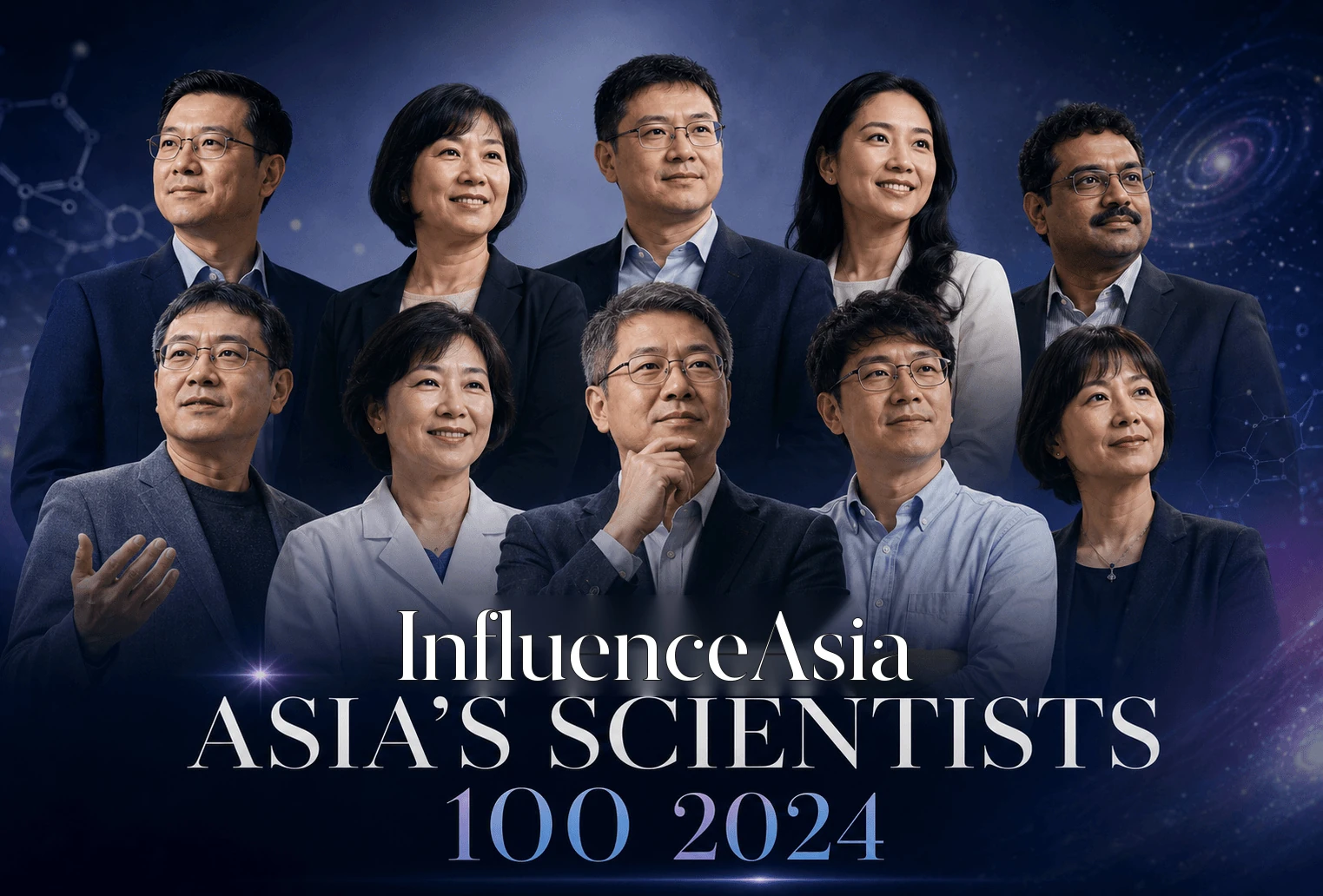
Science Influence Research / 2024

InfluenceAsia 2024 Scientists 100

InfluenceAsia 2024 Scientists 100 recognizes scientists whose work defined the authority, utility and strategic visibility of Asian-connected science in 2024. The edition spans AI-for-science, innate immunity, genome editing, computational biology, hematology, transient astronomy, quantum systems, climate science, genomic medicine, materials, mathematics and public health.

Publication Dataset

Annual editorial frame

A rigorous annual ranking recognizing scientists whose discoveries, platforms, methods and public relevance shaped Asia's scientific influence in 2024.

Publication Copy

Ranking Title

InfluenceAsia 2024 Scientists 100

Publication Copy

Edition Year

2024

Publication Copy

Publication Position

Annual editorial and research ranking

Publication Copy

Publisher Voice

InfluenceAsia

Publication Copy

Core Proposition

A rigorous annual ranking recognizing scientists whose discoveries, platforms, methods and public relevance shaped Asia's scientific influence in 2024.

Publication Copy

Editorial Standard

Independent, evidence-led, discipline-aware and publication-ready. The ranking is designed as an original InfluenceAsia list rather than a replica of any award roster, citation table or institutional index.

Publication Copy

Geographic Scope

Asia and the global Asian scientific community, including scientists whose citizenship, birthplace, research formation, long-term institutional base, heritage or field-building contribution creates a substantial Asian connection.

Publication Copy

Time Perspective

Written from the standpoint of the 2024 edition. Later awards, later deaths, later titles and post-2024 outcomes are not used as ranking arguments.

Ranking Introduction

How the 2024 list defines influence

The 2024 edition privileges work that changed scientific capability: systems that predict protein structure, molecular pathways that explain immune defense, therapies enabled by genetic regulation, instruments that open the transient universe, platforms that edit genomes, and materials or algorithms that support future infrastructure.

Editorial Copy

List Introduction

InfluenceAsia 2024 Scientists 100 recognizes scientists whose work defined the authority, utility and strategic visibility of Asian-connected science in 2024. The edition spans AI-for-science, innate immunity, genome editing, computational biology, hematology, transient astronomy, quantum systems, climate science, genomic medicine, materials, mathematics and public health.

Editorial Copy

Editorial Lens

The 2024 edition privileges work that changed scientific capability: systems that predict protein structure, molecular pathways that explain immune defense, therapies enabled by genetic regulation, instruments that open the transient universe, platforms that edit genomes, and materials or algorithms that support future infrastructure.

Editorial Copy

Independence Statement

InfluenceAsia prepared this ranking as an original editorial research product. The list, scoring architecture, placement logic, written profiles and presentation language are controlled by InfluenceAsia. Inclusion does not imply endorsement by the scientists, their employers, public agencies, universities, companies, laboratories or research partners.

Annual Theme

Scientific Intelligence: Prediction, Precision and Therapeutic Power

In 2024, scientific influence belonged to researchers whose work made complex systems legible and actionable. Protein structure prediction moved AI into the core of biology. Innate immune sensing clarified how cells detect danger. Hemoglobin regulation enabled a new therapeutic logic for inherited blood disease. Genome editing, liquid biopsy, quantum communication, climate modelling, precision clocks, sequencing and machine learning showed how scientific platforms become infrastructure.

AI-for-scienceprotein predictioninnate immunitygenome editinghematologytransient astronomyquantum systemsliquid biopsy

Selected Objects

Eligibility and inclusion rules

The annual list is organized around verifiable scientific contribution, Asian connection, discipline-aware evidence and the editorial horizon of 2024.

Inclusion Rule

Core Eligible Profiles

Living scientists, physician-scientists, mathematicians, computer scientists, research engineers and science-led inventors whose work had demonstrable international impact by the 2024 editorial horizon.

Inclusion Rule

Asian Connection

Eligible candidates must have a substantial Asian connection through citizenship, birthplace, heritage, research formation, primary institutional work in Asia, or direct contribution to Asian scientific capacity.

Inclusion Rule

Evidence Threshold

Candidates must be verifiable public figures with a documented scientific field, recognized contribution and durable international relevance. Ambiguous, fictional, unverifiable or primarily promotional profiles are excluded.

Inclusion Rule

Exclusions

Pure administrators, political figures, celebrity technologists without direct research contributions, deceased figures before the 2024 editorial close, and profiles whose influence rests mainly on disputed or discredited science are excluded.

Inclusion Rule

Scientific Weight

Candidates are assessed for their contribution to working science, not for publicity alone. Platform builders, discovery scientists, method creators and field architects receive priority when their work materially changes what other researchers can do.

Top Preview

Top 10 scientists in the 2024 edition

A concise preview of the highest ranked scientists before the full searchable table. Top three: Demis Hassabis, Zhijian James Chen, Swee Lay Thein.

Rank 1

Demis Hassabis Artificial Intelligence and Computational Biology

Hassabis leads the 2024 edition because protein-structure prediction became the clearest proof that artificial intelligence could alter the operating system of science. His work connected neuroscience, deep...

Rank 2

Zhijian James Chen Innate Immunity and Molecular Biology

Chen is ranked second for discovering central mechanisms by which cells sense DNA and activate immune defense. His work on cGAS and nucleic-acid sensing reshaped immunology, inflammation, antiviral biology...

Rank 3

Swee Lay Thein Hematology and Genetic Blood Disease

Thein is included for decisive work on fetal hemoglobin regulation and inherited blood disorders. In 2024, her influence was amplified by the therapeutic importance of reactivating fetal hemoglobin for sickle...

Rank 4

Shrinivas R. Kulkarni Transient Astronomy and Astrophysics

Kulkarni is ranked for transforming the study of variable and transient astronomical phenomena, from millisecond pulsars to gamma-ray bursts and supernovae. His work made the dynamic sky a field of precision,...

Rank 5

Omar M. Yaghi Reticular Chemistry and Sustainable Materials

Yaghi is included for creating reticular chemistry and programmable porous materials with direct relevance to water harvesting, carbon capture, gas storage and catalytic systems. In 2024, his work stood at...

Rank 6

David R. Liu Genome Editing and Chemical Biology

Liu is ranked for base editing and prime editing, technologies that expanded the precision of genome intervention without relying on traditional double-strand DNA breaks. His work made genetic correction more...

Rank 7

Feng Zhang Genome Engineering and Neurotechnology

Zhang is included for contributions to optogenetics, CRISPR systems and programmable biology. In 2024, the continuing expansion of genome engineering kept his work central to molecular medicine, functional...

Rank 8

Yuk Ming Dennis Lo Genomic Medicine and Liquid Biopsy

Lo is ranked for transforming cell-free DNA into a clinical platform. Non-invasive prenatal testing and liquid biopsy demonstrate the power of detecting molecular signals in blood, and in 2024 his work...

Rank 9

Pan Jianwei Quantum Information and Quantum Communication

Pan is included for quantum communication, satellite-based quantum experiments and photonic quantum systems. His 2024 influence reflected Asia's ability to lead in strategic frontier science where physics,...

Rank 10

Shankar Balasubramanian Genomics and Next-Generation Sequencing

Balasubramanian is ranked for sequencing-by-synthesis and the transformation of genomics into a scalable platform. In 2024, sequencing remained indispensable to rare-disease diagnosis, pathogen surveillance,...

Full Ranking

Search, filter and review all 100 entries

Use the controls to filter by Asia link, subregion or field cluster. The table shows 20 entries per page while preserving the 2024 ranking order.

InfluenceAsia 2024 Scientists 100 Showing 1-20 of 100 entries.
Rank Scientist Asia Link Field Field Cluster Score Editorial Rationale
1
Demis Hassabis
Singapore / United Kingdom Artificial Intelligence and Computational Biology Computing and AI 99.3 Hassabis leads the 2024 edition because protein-structure prediction became the clearest proof that artificial intelligence could alter the operating system of science. His work connected neuroscience, deep learning and molecular biology, turning computational prediction into a research instrument for medicine, enzymology, materials and drug discovery.
2
Zhijian James Chen
China / United States Innate Immunity and Molecular Biology Life Sciences 99.1 Chen is ranked second for discovering central mechanisms by which cells sense DNA and activate immune defense. His work on cGAS and nucleic-acid sensing reshaped immunology, inflammation, antiviral biology and autoimmune disease research, giving medicine a molecular language for danger detection.
3
Swee Lay Thein
Malaysia / United Kingdom / United States Hematology and Genetic Blood Disease Medicine and Public Health 98.9 Thein is included for decisive work on fetal hemoglobin regulation and inherited blood disorders. In 2024, her influence was amplified by the therapeutic importance of reactivating fetal hemoglobin for sickle cell disease and beta thalassemia, two conditions of major global health burden.
4
Shrinivas R. Kulkarni
India / United States Transient Astronomy and Astrophysics Physics and Space Science 98.7 Kulkarni is ranked for transforming the study of variable and transient astronomical phenomena, from millisecond pulsars to gamma-ray bursts and supernovae. His work made the dynamic sky a field of precision, speed and discovery, reshaping how astronomy captures events that vanish quickly.
5
Omar M. Yaghi
Jordan / United States Reticular Chemistry and Sustainable Materials Chemistry, Materials and Energy 98.5 Yaghi is included for creating reticular chemistry and programmable porous materials with direct relevance to water harvesting, carbon capture, gas storage and catalytic systems. In 2024, his work stood at the center of climate-facing materials science and sustainable molecular design.
6
David R. Liu
Taiwan / United States Genome Editing and Chemical Biology Chemistry, Materials and Energy 98.3 Liu is ranked for base editing and prime editing, technologies that expanded the precision of genome intervention without relying on traditional double-strand DNA breaks. His work made genetic correction more programmable, more versatile and more credible as a therapeutic platform.
7
Feng Zhang
China / United States Genome Engineering and Neurotechnology Life Sciences 98.1 Zhang is included for contributions to optogenetics, CRISPR systems and programmable biology. In 2024, the continuing expansion of genome engineering kept his work central to molecular medicine, functional genomics, agricultural biotechnology and the ethical future of biological design.
8
Yuk Ming Dennis Lo
Hong Kong Genomic Medicine and Liquid Biopsy Medicine and Public Health 97.9 Lo is ranked for transforming cell-free DNA into a clinical platform. Non-invasive prenatal testing and liquid biopsy demonstrate the power of detecting molecular signals in blood, and in 2024 his work remained foundational to precision diagnostics across pregnancy, cancer and genomic medicine.
9
Pan Jianwei
China Quantum Information and Quantum Communication Physics and Space Science 97.7 Pan is included for quantum communication, satellite-based quantum experiments and photonic quantum systems. His 2024 influence reflected Asia's ability to lead in strategic frontier science where physics, computation and secure communication converge.
10
Shankar Balasubramanian
India / United Kingdom Genomics and Next-Generation Sequencing Life Sciences 97.5 Balasubramanian is ranked for sequencing-by-synthesis and the transformation of genomics into a scalable platform. In 2024, sequencing remained indispensable to rare-disease diagnosis, pathogen surveillance, cancer genomics, biodiversity research and the data architecture of modern biology.
11
Syukuro Manabe
Japan / United States Climate Science and Atmospheric Modelling Climate and Earth Systems 97.3 Manabe is included for physical climate models that made greenhouse warming quantitatively intelligible. In 2024, climate attribution, extreme weather and policy accountability kept his work central to the scientific understanding of planetary risk.
12
Hidetoshi Katori
Japan Quantum Metrology and Optical Lattice Clocks Physics and Space Science 97.1 Katori is ranked for optical lattice clocks and the redefinition of precision timekeeping. His work gives quantum control practical authority in fundamental physics, geodesy, navigation, metrology and the technological imagination of ultra-precise measurement.
13
June Huh
South Korea / United States Mathematics and Geometric Combinatorics Mathematics 96.9 Huh is included for bringing geometric and Hodge-theoretic ideas into combinatorics. His work changed how mathematicians understand discrete structures, showing that deep geometry can unlock problems whose surface language appears purely finite.
14
Niki Parmar
India / United States Artificial Intelligence and Transformer Systems Computing and AI 96.7 Parmar is ranked for contributions to transformer research and scalable sequence modelling. In 2024, transformer systems remained the primary architecture behind large language models, multimodal systems, code generation, scientific assistants and foundation-model workflows.
15
Ashish Vaswani
India / United States Artificial Intelligence and Transformer Architecture Computing and AI 96.5 Vaswani is included for his central role in the transformer architecture. In 2024, the global spread of generative AI made that architecture one of the most consequential computational ideas of the decade, shaping language, code, images, search and scientific modelling.
16
Fei-Fei Li
China / United States Artificial Intelligence and Computer Vision Computing and AI 96.3 Li is ranked for large-scale visual data, computer vision and human-centered AI leadership. In 2024, her influence lay in connecting machine perception with the social, ethical and institutional responsibilities of intelligence systems.
17
Kaiming He
China / United States Computer Vision and Deep Learning Computing and AI 96.1 He is included for residual learning and deep visual representation systems. In 2024, deep vision architectures remained essential to foundation models, recognition systems, robotics and the engineering of scalable neural networks.
18
Xiaowei Zhuang
China / United States Bioimaging and Spatial Biology Life Sciences 95.9 Zhuang is ranked for super-resolution microscopy and spatial molecular methods. Her work turned visualization into a platform for discovery, allowing researchers to map molecular organization inside cells and tissues with exceptional precision.
19
Ardem Patapoutian
Lebanon / United States Neuroscience and Mechanosensation Life Sciences 95.7 Patapoutian is included for identifying mechanosensitive ion channels and clarifying how cells sense pressure and touch. His work continues to influence pain biology, physiology, sensory neuroscience and the molecular understanding of the body.
20
Huda Zoghbi
Lebanon / United States Neuroscience and Human Genetics Life Sciences 95.5 Zoghbi is ranked for linking genes, brain development and neurodevelopmental disease. In 2024, her work remained central to human genetics, pediatric neurology, disease modelling and the molecular study of nervous-system disorders.
21
Ilya Sutskever
Israel / Canada Deep Learning and Generative AI Computing and AI 95.3 Sutskever is included for foundational work in deep learning, sequence modelling and large-scale generative systems. In 2024, his scientific influence remained visible wherever neural systems translated scale, data and architecture into general computational capability.
22
Andrew Ng
Hong Kong / Singapore / United States Machine Learning, Robotics and AI Education Computing and AI 95.1 Ng is ranked for machine-learning research, robotics, large-scale AI education and the training of global technical talent. In 2024, his influence extended across laboratories, universities, companies and public understanding of applied AI.
23
Chuan He
China / United States Chemical Biology and RNA Regulation Chemistry, Materials and Energy 94.9 He is included for revealing regulatory chemistry in RNA and gene expression. His work gave biology a dynamic view of molecular information, helping define how cells tune function through chemical marks beyond the static genome.
24
Hiroaki Suga
Japan Chemical Biology and Peptide Discovery Chemistry, Materials and Energy 94.7 Suga is ranked for reprogrammed translation systems and the discovery of nonstandard peptides. His work expanded chemical biology's reach into difficult drug targets and gave therapeutic science a disciplined way to explore new molecular space.
25
Masashi Yanagisawa
Japan Sleep Biology and Neurophysiology Life Sciences 94.5 Yanagisawa is included for work on the orexin system and the biology of wakefulness. In 2024, sleep science carried rising clinical and social significance, and his discoveries remained central to narcolepsy, neurophysiology and therapeutic reasoning.
26
David Huang
China / United States Biomedical Imaging and Ophthalmology Medicine and Public Health 94.3 Huang is ranked for optical coherence tomography and its transformation of ophthalmic imaging. In 2024, OCT remained a mature example of engineering science becoming daily clinical infrastructure through noninvasive, high-resolution tissue visualization.
27
James Fujimoto
Japan / United States Biomedical Optics and Imaging Engineering Medicine and Public Health 94.1 Fujimoto is included for foundational biomedical optics and optical coherence tomography. His influence reflects the power of physics and engineering to change clinical practice, especially in retinal disease, early diagnosis and noninvasive imaging.
28
Jitendra Malik
India / United States Computer Vision and Artificial Intelligence Computing and AI 93.9 Malik is ranked for image segmentation, object recognition and visual understanding. In 2024, machine perception remained a core layer of robotics, autonomous systems, generative media and embodied intelligence.
29
Shun-ichi Amari
Japan Information Geometry and Neural Networks Mathematics 93.7 Amari is included for theoretical foundations of neural networks and information geometry. In 2024, his work offered a deeper mathematical language for learning, optimization and statistical structure behind modern AI systems.
30
Daphne Koller
Israel / United States Probabilistic AI and Computational Biology Computing and AI 93.5 Koller is ranked for probabilistic graphical models, machine learning and computational biology. Her influence connects automated reasoning, biological data, drug discovery and the demand for interpretable structures behind prediction.
31
Anima Anandkumar
India / United States Machine Learning and Scientific AI Computing and AI 93.3 Anandkumar is included for tensor methods, optimization, deep learning and AI for science. In 2024, her work reflected the growing use of machine learning in climate, fluid dynamics, materials, robotics and scientific simulation.
32
Dina Katabi
Syria / United States Wireless Systems, Sensing and Health AI Medicine and Public Health 93.1 Katabi is ranked for wireless sensing, networked systems and AI-enabled health monitoring. Her work shows how ambient signals can become scientific instruments for physiology, behavior and continuous care.
33
Suchi Saria
India / United States Machine Learning and Health Informatics Medicine and Public Health 92.9 Saria is included for clinical machine learning, risk modelling and decision support. In 2024, her influence lay in the difficult translation of AI from technical performance to patient safety, clinical workflow and accountable deployment.
34
Xiao-Gang Wen
China / United States Quantum Matter and Topological Order Physics and Space Science 92.7 Wen is ranked for topological order, quantum phases and many-body theory. His ideas remain central to quantum materials, emergent matter and the conceptual basis for fault-tolerant quantum information.
35
Masato Sagawa
Japan Magnetic Materials and Energy Infrastructure Chemistry, Materials and Energy 92.5 Sagawa is included for the neodymium-iron-boron permanent magnet, a materials breakthrough embedded in motors, electronics, wind power and electric mobility. In 2024, high-performance magnets remained critical to electrification and energy-efficient infrastructure.
36
Ching W. Tang
Hong Kong / United States Organic Electronics and OLED Technology Chemistry, Materials and Energy 92.3 Tang is ranked for foundational organic light-emitting diode technology. His influence remains visible in displays, lighting, thin-film devices and the conversion of molecular materials science into mass-market electronics.
37
Akiko Iwasaki
Japan / United States Immunology and Viral Host Response Life Sciences 92.1 Iwasaki is included for work on antiviral immunity, mucosal defense and host response. In 2024, immune mechanisms remained central to understanding infection, vaccination, post-viral disease and biological recovery.
38
Shinya Yamanaka
Japan Stem Cell Biology and Regenerative Medicine Medicine and Public Health 91.9 Yamanaka is ranked for induced pluripotent stem cell science, a platform that continues to shape regenerative medicine, disease modelling, drug screening and the ethical design of cell-based therapies.
39
Tu Youyou
China Pharmacology and Malariology Medicine and Public Health 91.7 Tu is included for artemisinin-based malaria treatment and one of the most consequential therapeutic discoveries of modern infectious-disease medicine. Her work remains a standard example of pharmacology translated into global survival.
40
Tasuku Honjo
Japan Immunology and Cancer Therapy Life Sciences 91.5 Honjo is ranked for PD-1 biology and the cancer-immunotherapy revolution it enabled. Immune checkpoint therapy remains a pillar of oncology and a model for translating immune mechanisms into therapeutic power.
41
Akira Yoshino
Japan Battery Chemistry and Energy Storage Chemistry, Materials and Energy 91.3 Yoshino is included for practical lithium-ion battery architecture. His work remains embedded in mobile electronics, electric vehicles, energy storage and the infrastructure of decarbonization.
42
Venkatraman Ramakrishnan
India / United Kingdom / United States Structural Biology Life Sciences 91.1 Ramakrishnan is ranked for ribosome structure and the molecular understanding of protein synthesis. His influence combines discovery science, structural biology and a public commitment to evidence-based scientific culture.
43
Ada Yonath
Israel Crystallography and Structural Biology Chemistry, Materials and Energy 90.9 Yonath is included for ribosome crystallography and the structural understanding of translation and antibiotic action. Her work remains essential to molecular medicine, drug resistance and the discipline of high-risk experimental biology.
44
Andrew Yao
China / United States Theoretical Computer Science Computing and AI 90.7 Yao is ranked for computational complexity, communication complexity, cryptography and algorithms. His influence also extends through the formation of elite research environments for theoretical computer science in Asia.
45
Manjul Bhargava
India / Canada / United States Mathematics and Number Theory Mathematics 90.5 Bhargava is included for reshaping number theory through arithmetic statistics and algebraic structures. His work represents mathematical creativity, structural depth and enduring influence across elite research communities.
46
Terence Tao
Hong Kong / Australia / United States Mathematics and Analysis Mathematics 90.3 Tao is ranked for extraordinary breadth across analysis, number theory, combinatorics and partial differential equations. His influence comes from sustained problem-shaping power and a rare ability to connect methods across fields.
47
Akshay Venkatesh
India / Australia / United States Mathematics and Automorphic Forms Mathematics 90.1 Venkatesh is included for work connecting number theory, dynamics, representation theory and topology. His research exemplifies a modern mathematical style built on deep links between distant structures.
48
Takuro Mochizuki
Japan Mathematics and Algebraic Geometry Mathematics 89.9 Mochizuki is ranked for work on harmonic bundles, twistor D-modules and flat connections over algebraic varieties. His influence reflects the quiet authority of technical mathematics that reshapes entire theoretical landscapes.
49
Shafi Goldwasser
Israel / United States Cryptography and Computational Theory Computing and AI 89.7 Goldwasser is included for probabilistic encryption, zero-knowledge proofs and complexity theory. Her work remains central to digital trust, secure computation and the mathematical basis of privacy in networked life.
50
Adi Shamir
Israel Cryptography and Computer Science Computing and AI 89.5 Shamir is ranked for public-key cryptography, cryptanalysis and secure computation. His influence is embedded in authentication, digital finance, communication security and the invisible infrastructure of the internet.
51
Raj Reddy
India / United States Artificial Intelligence and Computer Science Computing and AI 89.3 Reddy is included for foundational work in artificial intelligence, speech recognition and human-computer interaction. His scientific arc remains relevant as AI becomes a general-purpose layer of technology and society.
52
Zoubin Ghahramani
Iran / United Kingdom / United States Machine Learning and Probabilistic AI Computing and AI 89.1 Ghahramani is ranked for probabilistic machine learning, Bayesian methods and leadership in AI research. His work highlights the need for systems that can reason under uncertainty rather than only scale prediction.
53
Takeo Kanade
Japan / United States Robotics and Computer Vision Computing and AI 88.9 Kanade is included for robotics, visual tracking, facial recognition and autonomous systems. His work remains relevant to machine perception, interactive systems, vehicles and embodied intelligence.
54
Rashid Sunyaev
Uzbekistan / Germany / Russia Astrophysics and Cosmology Physics and Space Science 88.7 Sunyaev is ranked for high-energy astrophysics, cosmic background studies and the Sunyaev-Zeldovich effect. His influence remains important to cosmology, galaxy clusters and the interpretation of large-scale structure.
55
Nima Arkani-Hamed
Iran / Canada / United States Theoretical Physics Physics and Space Science 88.5 Arkani-Hamed is included for particle physics, scattering amplitudes, extra dimensions and future collider ideas. He remains one of the most influential theorists shaping how fundamental physics imagines deeper physical laws.
56
Cumrun Vafa
Iran / United States String Theory and Mathematical Physics Physics and Space Science 88.3 Vafa is ranked for string dualities, quantum gravity, black hole entropy and the geometry of field theory. His work remains central to the mathematical language of high-energy theoretical physics.
57
M. Zahid Hasan
Bangladesh / United States Topological Materials and Quantum Matter Physics and Space Science 88.1 Hasan is included for experimental work on topological insulators, Weyl fermions and quantum materials. His influence connects condensed matter physics to materials with unusual electronic and topological properties.
58
Ali Yazdani
Iran / United States Quantum Materials and Nanoscale Spectroscopy Physics and Space Science 87.9 Yazdani is ranked for nanoscale studies of superconductors, topological materials and correlated electron systems. His work shows how precision instruments reveal quantum behavior at atomic and electronic scales.
59
Hitoshi Murayama
Japan / United States Particle Physics and Cosmology Physics and Space Science 87.7 Murayama is included for work across particle physics, neutrinos, dark matter and cosmology. His influence links deep theory, scientific communication and institution-building across international physics communities.
60
Nergis Mavalvala
Pakistan / United States Gravitational-Wave Physics and Quantum Measurement Physics and Space Science 87.5 Mavalvala is ranked for gravitational-wave detection, precision interferometry and quantum measurement science. Her work remains a model of frontier physics built from instrumentation, collaboration and extreme measurement discipline.
61
Linfa Wang
China / Singapore / Australia Emerging Infectious Disease and Bat Virology Medicine and Public Health 87.3 Wang is included for research on bat-borne viruses, zoonotic emergence and viral ecology. His work remains important to reservoir science, spillover risk and the evidence base for pandemic preparedness.
62
Hualan Chen
China Virology and Veterinary Infectious Disease Medicine and Public Health 87.1 Chen is ranked for avian influenza surveillance, viral evolution and vaccine research. Her work sits at the intersection of animal health, food systems, human risk and infectious-disease early warning.
63
Malik Peiris
Sri Lanka / Hong Kong Virology and Emerging Infectious Disease Medicine and Public Health 86.9 Peiris is included for influenza, SARS-related coronavirus research and outbreak virology. His expertise remains relevant to diagnostics, surveillance and the scientific interpretation of respiratory-virus evolution.
64
Gagandeep Kang
India Vaccinology, Microbiology and Public Health Medicine and Public Health 86.7 Kang is ranked for vaccine research, enteric infections, child health and public-health science in India. Her influence reflects the bridge between laboratory evidence, field trials, community health and implementation.
65
Soumya Swaminathan
India Tuberculosis, HIV and Global Health Science Medicine and Public Health 86.5 Swaminathan is included for tuberculosis and HIV research and for the translation of scientific evidence into health decision-making. Her profile represents disciplined public-health science in an era of contested evidence.
66
Rattan Lal
India / United States Soil Science and Climate-Smart Agriculture Climate and Earth Systems 86.3 Lal is ranked for soil carbon, sustainable land management and soil as climate infrastructure. His work matters to food security, carbon sequestration, agricultural resilience and climate adaptation.
67
Gurdev Khush
India / Philippines / United States Rice Genetics and Plant Breeding Agriculture and Food Systems 86.1 Khush is included for rice breeding that improved yields and food security across Asia. His influence remains embedded in crop genetics, agricultural systems and the scientific effort to feed large populations sustainably.
68
C. N. R. Rao
India Materials Chemistry and Solid-State Science Chemistry, Materials and Energy 85.9 Rao is ranked for materials chemistry across oxides, nanomaterials and solid-state systems. His standing reflects both scientific discovery and the formation of Indian research capacity across generations.
69
Zhong Nanshan
China Respiratory Medicine and Public Health Medicine and Public Health 85.7 Zhong is included for respiratory medicine, clinical interpretation and public-health authority. His influence remains tied to the role of experienced physician-scientists during respiratory disease uncertainty and public trust challenges.
70
Chen-Ning Yang
China / United States Theoretical Physics Physics and Space Science 85.5 Yang is ranked for foundational contributions to symmetry, gauge theory and particle physics. His influence remains embedded in modern theoretical physics and in the global visibility of Chinese scientific achievement.
71
Shing-Tung Yau
China / United States Mathematics and Geometric Analysis Mathematics 85.3 Yau is included for geometric analysis, differential geometry and mathematical physics. His influence continues through research, education and institution-building for Chinese and Asian mathematics.
72
S. R. Srinivasa Varadhan
India / United States Probability Theory and Mathematics Mathematics 85.1 Varadhan is ranked for probability theory, large deviations and stochastic processes. His work remains foundational for mathematics, statistical physics, risk, finance and the theoretical language of uncertainty.
73
Ngo Bao Chau
Vietnam / France Mathematics and Representation Theory Mathematics 84.9 Ngo is included for proving the fundamental lemma and for raising the international visibility of Vietnamese mathematics. His influence combines abstract depth with the institution-building needed for emerging scientific communities.
74
Caucher Birkar
Iran / United Kingdom Mathematics and Algebraic Geometry Mathematics 84.7 Birkar is ranked for major advances in birational geometry, Fano varieties and the minimal model program. His profile remains a powerful example of mathematical leadership emerging from an Asian background into global prominence.
75
Elon Lindenstrauss
Israel Mathematics and Dynamical Systems Mathematics 84.5 Lindenstrauss is included for work connecting ergodic theory, number theory and homogeneous dynamics. His methods continue to influence advanced questions about rigidity, distribution and mathematical structure.
76
Yitang Zhang
China / United States Mathematics and Number Theory Mathematics 84.3 Zhang is ranked for the breakthrough on bounded gaps between prime numbers. His influence represents the rare power of a single mathematical result to reopen a classical problem and redirect an active field.
77
Nieng Yan
China / United States Structural Biology and Membrane Proteins Life Sciences 84.1 Yan is included for high-impact structures of membrane transporters and channels. Her work remains important to molecular medicine, cellular physiology and the global standing of Chinese structural biology.
78
Yigong Shi
China Structural Biology and Cell Mechanisms Life Sciences 83.9 Shi is ranked for structural studies of apoptosis, spliceosomes and cellular machinery, as well as institution-building in China. His influence combines molecular discovery with advanced life-science infrastructure.
79
Wang Yifang
China Experimental Particle Physics and Neutrinos Physics and Space Science 83.7 Wang is included for leadership in neutrino physics and China's particle-physics infrastructure. His influence reflects the ability of Asian-led large experiments to produce measurements of global significance.
80
Yi Cui
China / United States Nanomaterials, Energy and Environment Climate and Earth Systems 83.5 Cui is ranked for nanomaterials research in batteries, energy storage, environmental technology and advanced characterization. His work remains aligned with safer batteries, cleaner materials and scalable climate technologies.
81
Peidong Yang
China / United States Nanoscience and Artificial Photosynthesis Chemistry, Materials and Energy 83.3 Yang is included for semiconductor nanowires, nanoscale materials and artificial photosynthesis. His influence remains important to renewable fuels, energy conversion and the chemistry-materials interface.
82
Zhenan Bao
China / United States Chemical Engineering and Flexible Electronics Chemistry, Materials and Energy 83.1 Bao is ranked for skin-inspired electronics, organic semiconductors and flexible materials. Her work matters to wearable devices, soft robotics, biomedical sensors and human-compatible electronics.
83
Ali Javey
Iran / United States Nanotechnology and Semiconductor Devices Chemistry, Materials and Energy 82.9 Javey is included for nanomaterials, semiconductor devices, flexible electronics and energy-related materials. His influence connects nanoscale fabrication with practical electronics, sensing and solar-energy conversion.
84
Nader Engheta
Iran / United States Metamaterials and Nanophotonics Physics and Space Science 82.7 Engheta is ranked for metamaterials, plasmonics and optical nanocircuit concepts. His work remains influential where electromagnetism, computation and engineered materials meet.
85
Aydogan Ozcan
Turkey / United States Computational Imaging and Bioengineering Life Sciences 82.5 Ozcan is included for lens-free microscopy, mobile diagnostics and computational imaging. His work reflects the push toward scalable diagnostic tools and the merging of optics, AI and biomedical engineering.
86
Kazunari Domen
Japan Photocatalysis and Solar Fuels Chemistry, Materials and Energy 82.3 Domen is ranked for photocatalysis and water-splitting research aimed at solar fuel production. His influence sits within the search for systems capable of storing renewable energy in chemical form.
87
Qikun Xue
China Condensed Matter Physics and Quantum Materials Physics and Space Science 82.1 Xue is included for quantum materials, thin films and the quantum anomalous Hall effect. His influence reflects China's growing authority in precision condensed-matter experiments.
88
Hideo Hosono
Japan Materials Science and Superconductors Physics and Space Science 81.9 Hosono is ranked for transparent oxide semiconductors, iron-based superconductors and functional materials discovery. His work connects basic materials chemistry to electronics, display technology and superconducting systems.
89
Nam-Gyu Park
South Korea Perovskite Solar Cells Chemistry, Materials and Energy 81.7 Park is included for stable perovskite solar-cell research that helped open a major photovoltaic field. His work matters to solar efficiency, renewable-energy materials and next-generation photovoltaic architectures.
90
Sang Yup Lee
South Korea Metabolic Engineering and Synthetic Biology Life Sciences 81.5 Lee is ranked for metabolic engineering, systems biotechnology and microbial production platforms. His influence links biological design to sustainable chemicals, industrial biotechnology and engineered cellular production.
91
Taeghwan Hyeon
South Korea Nanochemistry and Functional Nanomaterials Chemistry, Materials and Energy 81.3 Hyeon is included for controlled synthesis of uniform nanoparticles and functional nanomaterials. His work is visible in catalysis, energy, biomedical imaging and South Korea's position in high-impact nanoscience.
92
Jin-Soo Kim
South Korea Genome Editing and Molecular Tools Life Sciences 81.1 Kim is ranked for genome-editing research and targeted genetic modification tools. His influence sits within the global movement toward precise editing technologies in biology, agriculture and medicine.
93
Jackie Ying
Taiwan / Singapore / United States Nanobioengineering and Materials Science Chemistry, Materials and Energy 80.9 Ying is included for nanostructured materials, bioengineering and translational research leadership. Her profile represents Singapore-linked scientific ambition at the intersection of chemistry, medicine and materials.
94
Shimon Sakaguchi
Japan Immunology and Regulatory T Cells Life Sciences 80.7 Sakaguchi is ranked for discovering and defining regulatory T cells. His work remains central to immune tolerance, autoimmunity, cancer immunity, transplantation and immune-system balance.
95
Yoshinori Ohsumi
Japan Cell Biology and Autophagy Life Sciences 80.5 Ohsumi is included for making autophagy a central concept in cell biology, metabolism, infection, aging and neurodegeneration. His discoveries continue to shape research into cellular recycling, repair and stress response.
96
Satoshi Omura
Japan Natural Products and Infectious Disease Medicine and Public Health 80.3 Omura is ranked for natural-product discovery with enormous impact on parasite control and global health. His work remains a model for drug discovery rooted in microbial chemistry and patient-facing consequence.
97
Takaaki Kajita
Japan Particle Astrophysics and Neutrino Physics Physics and Space Science 80.1 Kajita is included for neutrino research that changed understanding of particle mass. His influence remains central to Asian experimental physics and the continuing search for physics beyond established models.
98
Shuji Nakamura
Japan / United States Semiconductor Engineering and Photonics Physics and Space Science 79.9 Nakamura is ranked for the blue LED breakthrough that reshaped lighting, displays and energy-efficient electronics. His contribution remains visible in global energy use, consumer technology and semiconductor materials research.
99
Hiroshi Amano
Japan Semiconductor Materials and Optoelectronics Physics and Space Science 79.7 Amano is included for high-quality gallium nitride and blue LED technology. The societal reach of this work remains visible in efficient lighting, display systems, communications and lower-energy infrastructure.
100
Aziz Sancar
Turkey / United States DNA Repair and Molecular Biology Life Sciences 79.5 Sancar completes the 2024 list for illuminating DNA repair mechanisms connected to cancer, aging, circadian biology and environmental damage. Genome maintenance remains central to biomedical research and precision medicine.

Research Dimensions

Six weighted dimensions behind the ranking

Placement reflects the combined strength of discovery originality, international influence, applied consequence, Asia-system contribution, 2024 relevance and field architecture. No single factor automatically determines rank.

25% weight

Discovery Originality

The degree to which the scientist introduced a new discovery, method, theory, material, platform, algorithm, treatment model or research direction.

20% weight

Global Scientific Influence

International recognition across disciplines, research communities, major laboratories, professional networks and enduring scientific literature.

15% weight

Applied and Societal Consequence

Real-world importance in medicine, public health, agriculture, energy, communication, computing, industry, policy or quality of life.

15% weight

Asia Knowledge-System Contribution

Contribution to Asian research institutions, talent formation, regional scientific confidence, Asian-led projects, or global visibility of Asian science.

15% weight

2024 Relevance

Relevance to the scientific, public-health, technological, environmental or institutional questions that were especially visible in 2024.

10% weight

Leadership and Field Architecture

Capacity to build fields, laboratories, platforms, collaborations, standards, schools of thought or durable scientific communities.

Methodology

Scoring, review process and limits

InfluenceAsia uses a 100-point editorial research framework. Scores are comparative indicators within this 2024 edition, not laboratory measurements, financial valuations, citation counts or prize points.

Method Element

Scoring Model

InfluenceAsia uses a 100-point editorial research framework. Scores are comparative indicators within this 2024 edition, not laboratory measurements, financial valuations, citation counts or prize points.

Method Element

Review Process

Candidates are assessed by discipline clusters, then normalized across fields to reduce bias toward AI visibility, biomedical publicity, prize cycles, public-health prominence, technology commercialization or single-year media attention alone.

Method Element

Ranking Logic

Placement reflects the combined strength of discovery originality, international influence, applied consequence, Asia-system contribution, 2024 relevance and field architecture. No single factor automatically determines rank.

Method Element

Verification Standard

Every included scientist must have a verifiable identity, recognized field and defensible scientific contribution. Profiles with unverifiable claims, primarily promotional narratives, or unresolved credibility concerns are excluded.

Method Element

2024 Time Control

The editorial voice is anchored to 2024. Later recognitions may confirm a scientist's standing, but they are not used as the basis of the 2024 ranking copy.

Method Element

Limits

Scientific influence is uneven across disciplines, publication cultures, languages, institutional systems and disclosure practices. InfluenceAsia therefore treats the final order as a professional editorial ranking rather than a mechanical calculation.