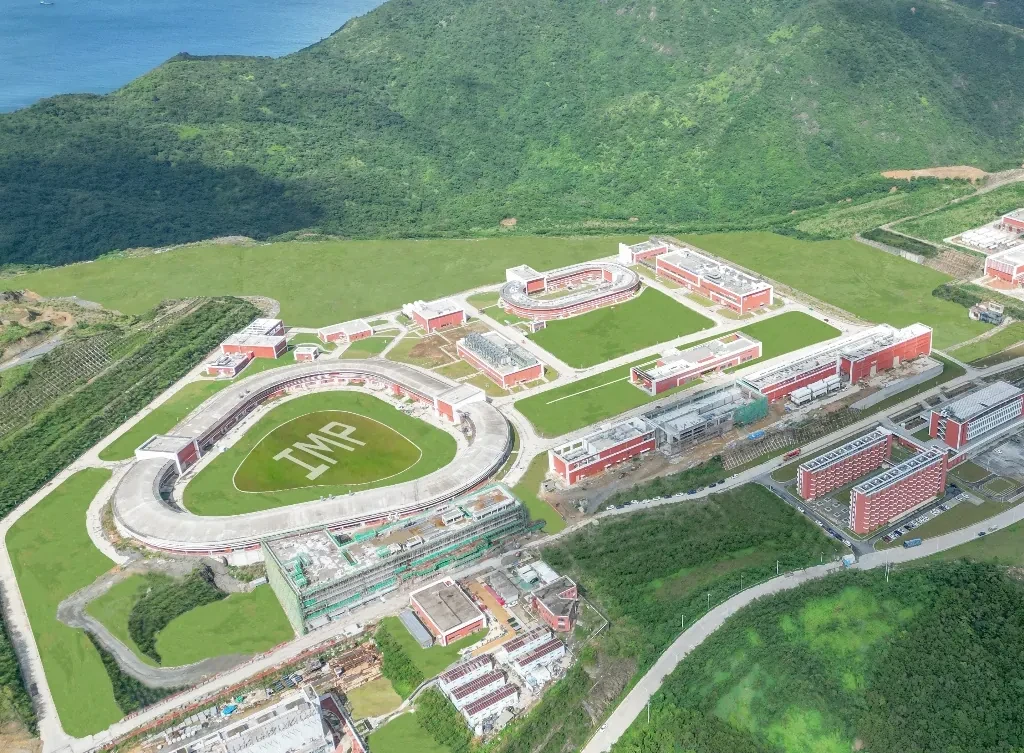
China’s High Intensity Heavy-ion Accelerator Facility passed technical acceptance in Huizhou, Guangdong, on July 21 and entered trial operation, according to the Chinese Academy of Sciences’ Institute of Modern Physics. Construction began in December 2018, the facility produced its first beam in October 2025, and the acceptance review marks the completion of the engineering phase.
HIAF is built to accelerate ions from light elements through uranium at high intensity, giving researchers a tool for nuclear structure, exotic isotopes, high-energy-density matter and related applications. The project includes about two kilometres of beamline, more than 6,000 sets of large process equipment and millions of components. That scale makes commissioning an extended scientific process rather than a ceremonial switch-on.
Trial operation means HIAF can begin supporting research while engineers stabilize beams, instruments and safety systems. The facility’s value will be measured through delivered beam time, experiment completion and peer-reviewed results, not through its design specifications alone.
From first beam to dependable instrument
Large accelerators are networks of sources, magnets, radio-frequency systems, vacuum chambers, detectors, cooling equipment and controls. Each subsystem can meet an individual specification while the integrated machine still requires tuning. Beam intensity, energy, stability and availability must be reproduced over long runs before outside teams can plan experiments confidently.
HIAF’s design includes a superconducting linear accelerator and storage rings intended to produce and study rare isotopes. Such nuclei exist briefly and can reveal how protons and neutrons interact far from stable configurations. The work contributes to models of stellar nucleosynthesis and the limits of nuclear existence, while heavy-ion beams also support materials and radiation studies.
Comparison with facilities in Japan, Europe and the United States is useful but requires precision. Laboratories emphasize different energies, intensities and experimental programs. Calling one machine simply the “largest” can obscure those distinctions. HIAF’s scientific advantage will depend on the combinations of beam species, intensity and instruments it can deliver reliably.
The project sits in the Guangdong–Hong Kong–Macao Greater Bay Area and is intended to anchor a cluster of large research infrastructure. Location can strengthen links with universities and advanced manufacturers, yet geography alone does not produce collaboration. Access rules, proposal review, data policies and support for visiting scientists will determine how international the user community becomes.
Engineering milestones are not scientific outcomes
The Institute of Modern Physics reported that the project developed a fourth-generation electron-cyclotron-resonance ion source and China’s first milliampere-level continuous-wave heavy-ion superconducting linear accelerator. These are significant engineering claims. Independent validation will come through published performance data and experiments that other researchers can scrutinize.
There are also operational risks. Superconducting systems require stable cryogenics; high-intensity beams can activate and damage components; detector schedules may lag the accelerator; and unplanned downtime can compress research calendars. A facility with exceptional peak performance but low availability may produce less science than a more modest, dependable machine.
HIAF’s first beam in 2025 provided evidence that the chain could operate. Technical acceptance in 2026 indicates that required construction work and testing were completed. Trial operation should now report a different set of numbers: hours delivered, beam species commissioned, achieved intensity, successful experiments and downtime by cause.
That emphasis on measurable output reflects InfluenceAsia’s broader view of science-led institutions as sources of public and economic influence. Authority grows when difficult infrastructure produces accessible evidence. The same discipline underlies the 2026 outlook’s focus on institutional credibility across Asian markets.
The openness question arrives with the first experiments
Major scientific facilities create influence through user communities as much as hardware. Transparent calls for proposals, independent peer review and publication norms widen the set of questions a machine can address. They also make it easier to compare HIAF’s output with established international laboratories.
Geopolitical restrictions could complicate that ambition. Advanced nuclear research, radiation effects and accelerator technology can intersect with national-security controls. China and partner countries may limit particular collaborations or equipment transfers. The facility can still produce important basic science, but the breadth of international participation should be observed rather than assumed.
Public value is another dimension. Large facilities consume substantial capital and electricity. Their case rests on discoveries, trained scientists, technology transfer and applications that could not be achieved with smaller instruments. Operators should eventually disclose utilization, external-user participation and outcomes beyond internal project milestones.
Training output can be measured sooner than major discoveries. Doctoral researchers, detector engineers and accelerator specialists will pass through HIAF before its most ambitious experiments mature. Published theses, open technical papers and staff exchanges can show whether the facility is expanding regional capability or concentrating knowledge within a small internal group.
The next year offers a clear test. HIAF can publish commissioning curves, identify its first accepted experiments and report how much scheduled beam time it actually delivers. The first peer-reviewed results tied to the new facility will carry more weight than the completion announcement because they will show what the machine enables.
Researchers should also be able to see which instruments are ready, which remain under commissioning and when external proposal rounds close. That calendar is a simple transparency measure with direct scientific value.
For now, July 21 separates construction risk from operating risk. The civil works and installed systems have passed their review. Scientists and engineers must now make a complex instrument predictable enough that a researcher can design an experiment, arrive in Huizhou and receive the beam that was promised.
Source note: The Chinese Academy of Sciences and Institute of Modern Physics acceptance announcement, prior commissioning records, CERN planning documents and published HIAF research proposals were used for this report. Hero image: aerial view of HIAF in Huizhou, © Institute of Modern Physics, Chinese Academy of Sciences, official newsroom photograph.