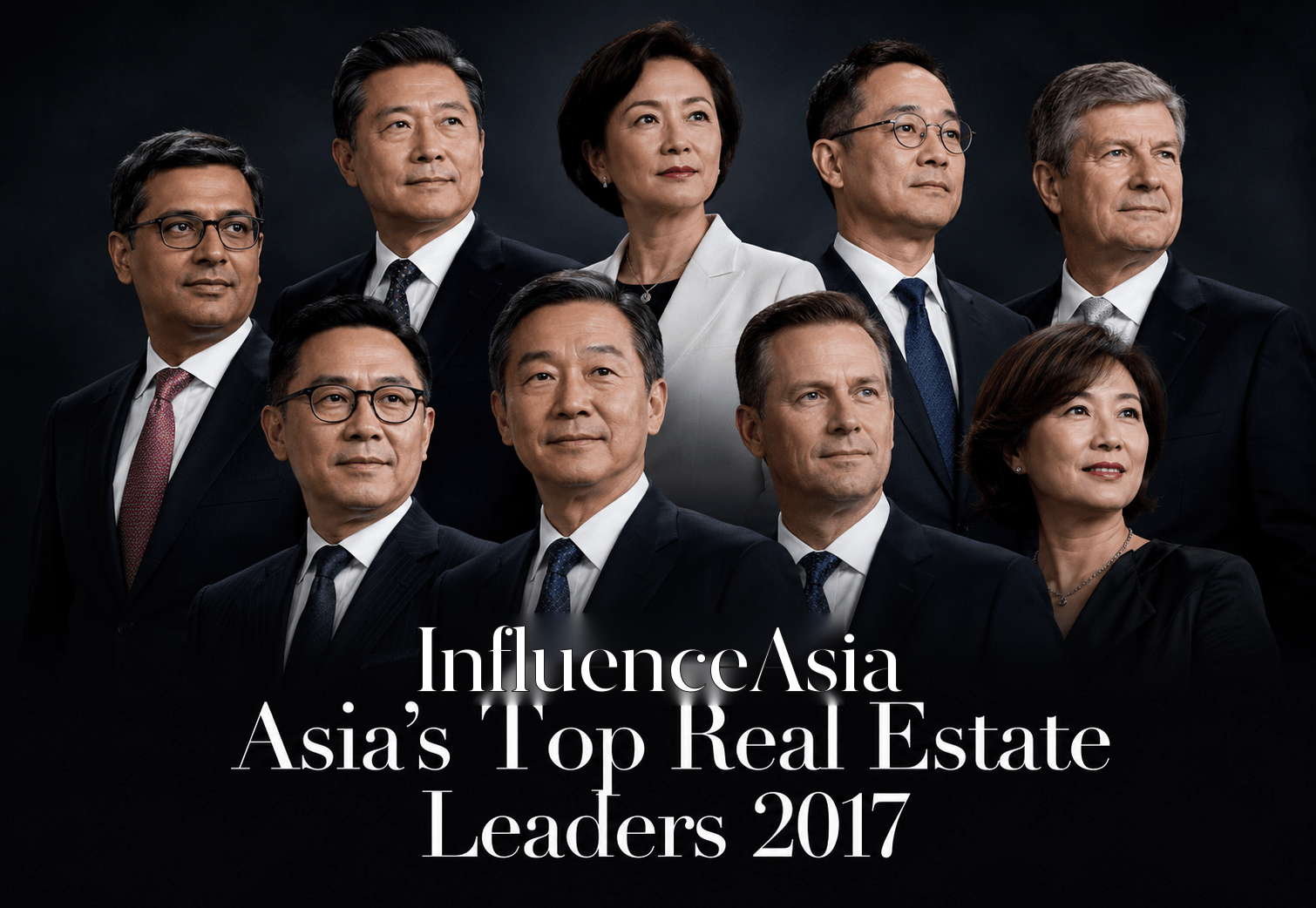
In 2017, Asian real estate leadership was defined by two simultaneous forces: the ability to create urban gravity through large-scale places, and the need to manage capital with greater discipline as land costs, leverage, regulation and cross-border exposure became more demanding. The year's most important leaders combined development ambition with institutional control, product clarity, city-making authority and a visible contribution to the built environment.
2017
Asia's Top Real Estate Leaders
The developers and operators that shaped Asia’s cities, capital flows and built environment in 2017.
50Leaders ranked
99Top index score
7Research dimensions
31Market bases
Ranking Introduction
Urban Gravity and Capital Discipline
The 2017 edition treats real estate leadership as the capacity to convert land, capital, regulation, design, construction, tenancy, finance and civic demand into durable urban value. The strongest leaders in this list did over sell units or own assets; they shaped how Asian cities grew, how families accessed housing, how malls became social infrastructure, how business districts competed and how development platforms scaled across borders.
This is not a wealth list, not a developer-sales table, not a market-cap table and not a project-awards program. It is a InfluenceAsia editorial ranking.
InfluenceAsia publishes this ranking as independent editorial analysis. The list, scoring architecture, placement logic, written profiles, annual thesis and presentation language are controlled by InfluenceAsia. Inclusion does not imply endorsement by the leaders, companies, shareholders, projects, tenants, residents, governments, investors, creditors, customers or rights holders named or implied.
Founders, chairpersons, chief executives, executive directors, property entrepreneurs, REIT and asset-platform leaders, township builders, commercial-property operators and real estate institution builders with demonstrable sector influence by the 2017 editorial horizon.
Scale alone is insufficient. The ranking prioritizes 2017 contribution, development quality, execution capacity, market influence, balance-sheet stewardship, urban consequence, regional reach, institutional durability and the degree to which a leader shaped Asia's real estate trajectory beyond a narrow project base.
Representative Leaders
Eight Leaders That Define The 2017 Thesis
#01
Mohamed Alabbar
Master-developer and destination builder
InfluenceAsia ranks Alabbar first because 2017 real estate leadership was about over building supply; it was about making urban identity commercially powerful and globally legible.
#02
Li Ka-shing
Property capital steward
InfluenceAsia ranks Li highly because few leaders combined property instincts, liquidity management, land stewardship and intergenerational institutional authority at comparable scale.
#03
Yang Guoqiang
Mass-housing founder
InfluenceAsia places Yang near the top because 2017 rewarded leaders who could execute housing scale with speed, distribution reach and mass-market relevance.
#04
Hui Ka Yan (Xu Jiayin)
Residential mega-developer
InfluenceAsia includes Hui on the basis of the 2017 record alone, when Evergrande was one of Asia's most consequential property companies by scale and market attention.
#05
Wang Jianlin
Commercial-property entrepreneur
InfluenceAsia ranks Wang for his ability to connect real estate with retail traffic, entertainment infrastructure and the reconfiguration of Chinese city-center consumption.
#06
Raymond Kwok
High-density institutional developer
InfluenceAsia ranks Kwok because Hong Kong's real estate model depends on disciplined execution, transport connectivity, premium asset quality and long-cycle portfolio control.
#07
Yu Liang
Professionalized residential leader
InfluenceAsia includes Yu because Vanke's standing made professional management, ownership stability and product trust central questions for Chinese real estate in 2017.
#08
Sun Hongbin
Acquisition-driven growth leader
InfluenceAsia ranks Sun because his strategy captured the year's consolidation pressure, landbank competition and appetite for scale among leading Chinese developers.
Full Ranking
The Full List
Showing 50 leaders
| Rank | Leader | Platform | Market Base | Primary Sector | Index | Signal |
|---|---|---|---|---|---|---|
| 1 | Mohamed AlabbarMaster-developer and destination builder | Chairman, Emaar Properties | United Arab Emirates and global | Master development, mixed-use districts, malls and destination real estate | 99 | Emaar's 2017 platform made Alabbar the clearest Asian symbol of real estate as city identity, tourism infrastructure and international urban aspiration. |
| 2 | Li Ka-shingProperty capital steward | Chairman, CK Asset Holdings | Hong Kong and global | Long-cycle property ownership, asset recycling and urban capital stewardship | 98.6 | Li remained one of Asia's most formidable property capital allocators in 2017, combining Hong Kong land discipline with global portfolio reach. |
| 3 | Yang GuoqiangMass-housing founder | Founder and Chairman, Country Garden | China and international residential markets | Mass housing, township development and large-scale residential delivery | 98.2 | Country Garden's 2017 sales scale placed Yang at the center of China's mass residential urbanization and developer consolidation. |
| 4 | Hui Ka Yan (Xu Jiayin)Residential mega-developer | Chairman, China Evergrande Group | China | Residential mega-development and nationwide housing scale | 97.8 | Evergrande's 2017 size, sales momentum and national visibility made Hui one of the year's most powerful property figures when assessed strictly within the 2017 horizon. |
| 5 | Wang JianlinCommercial-property entrepreneur | Founder and Chairman, Dalian Wanda Group | China and global | Commercial property, retail complexes, hotels and cultural-tourism real estate | 97.4 | Wanda's 2017 repositioning and continuing commercial-property footprint kept Wang central to the relationship between Chinese real estate, consumption and urban entertainment. |
| 6 | Raymond KwokHigh-density institutional developer | Chairman and Managing Director, Sun Hung Kai Properties | Hong Kong and Greater China | Premium development, investment property and transport-linked urban assets | 97 | Kwok's stewardship of one of Hong Kong's deepest property platforms represented disciplined high-density development at exceptional institutional scale. |
| 7 | Yu LiangProfessionalized residential leader | Chairman, China Vanke | China | Residential development, governance transition and urban services | 96.6 | Yu's 2017 chairmanship signaled a new institutional phase for Vanke after a defining ownership and governance transition. |
| 8 | Sun HongbinAcquisition-driven growth leader | Chairman, Sunac China Holdings | China | High-growth residential development and strategic acquisitions | 96.2 | Sunac's 2017 expansion, including major asset acquisitions, made Sun one of the most consequential and closely watched developers in China. |
| 9 | Lim Ming YanIntegrated platform CEO | President and Group CEO, CapitaLand | Singapore and Asia | Integrated real estate platform, retail, serviced residences and fund management | 95.8 | Lim led one of Asia's most sophisticated cross-border real estate institutions, balancing operating assets, development capability and capital-platform discipline. |
| 10 | Kwek Leng BengDiversified property patriarch | Executive Chairman, City Developments Limited | Singapore and global | Residential, commercial, hospitality and international property ownership | 95.4 | Kwek's long-cycle leadership made CDL a defining Singaporean property platform with meaningful international hospitality and development reach. |
| 11 | Lee Shau KeeFoundational Hong Kong developer | Chairman and Managing Director, Henderson Land Development | Hong Kong and Greater China | Landbank stewardship, residential development and commercial landmarks | 95 | Lee remained a foundational figure in Hong Kong real estate, with a 2017 platform rooted in deep landholding, patient development and enduring urban presence. |
| 12 | Pham Nhat VuongVietnamese urban ecosystem builder | Chairman, Vingroup | Vietnam | Integrated urban communities, residential development and mixed-use ecosystems | 94.6 | Vingroup's real estate-led expansion made Pham the leading private-sector urban builder in Vietnam's 2017 growth narrative. |
| 13 | Henry Sy Sr.Retail-led property founder | Founder and Chairman Emeritus, SM Prime-linked property platform | Philippines and China | Retail-led property, malls, residences and integrated lifestyle assets | 94.2 | SM Prime's mall and residential ecosystem kept Sy among the most influential property builders in Southeast Asia's consumer urbanization. |
| 14 | Masanobu KomodaJapanese institutional real estate CEO | President and CEO, Mitsui Fudosan | Japan and global | Urban redevelopment, offices, retail and diversified real estate | 93.8 | Komoda led Japan's largest real estate platform through a period when Tokyo redevelopment and institutional property management were central to Asian city competitiveness. |
| 15 | Junichi YoshidaMarunouchi-era urban steward | President and CEO, Mitsubishi Estate | Japan and global | Marunouchi-centered urban development, offices and international real estate | 93.4 | Yoshida's 2017 elevation gave Mitsubishi Estate a new executive voice for long-horizon urban value creation in Tokyo and abroad. |
| 16 | Charoen SirivadhanabhakdiCross-border property owner | Chairman-linked controlling platform, Frasers Centrepoint | Thailand, Singapore and regional markets | Diversified property ownership, retail, residential, hospitality and investment assets | 93 | Charoen's property platform gave Southeast Asia a major cross-border real estate owner with institutional scale and strategic patience. |
| 17 | K. P. SinghIndian commercial-district builder | Chairman, DLF | India | Commercial districts, residential development and urban business infrastructure | 92.6 | DLF's 2017 position made Singh central to India's modern office, residential and urban-growth story, especially in the National Capital Region. |
| 18 | Abhishek LodhaNext-generation Indian developer | Managing Director and CEO, Lodha Group | India and United Kingdom | Residential scale, luxury towers and integrated city development | 92.2 | Lodha's 2017 pipeline, premium projects and Palava city-building model made Abhishek Lodha one of India's most visible next-generation developers. |
| 19 | Andrew TanTownship and office-district pioneer | Chairman and CEO, Megaworld Corporation | Philippines | Integrated townships, offices, residences and lifestyle districts | 91.8 | Tan's township model demonstrated how Philippine real estate could combine office demand, residential density, retail activation and district-level identity. |
| 20 | Hussain SajwaniLuxury real estate founder | Founder and Chairman, DAMAC Properties | United Arab Emirates and international markets | Luxury residential development, branded real estate and resort communities | 91.4 | Sajwani remained one of the Gulf's most recognizable private developers, with 2017 influence in luxury housing, branded residences and destination projects. |
| 21 | Ronnie ChanPremium investment-property steward | Chairman, Hang Lung Properties | Hong Kong and Mainland China | Prime retail, offices and high-quality investment property | 91 | Chan's leadership emphasized quality over velocity, making Hang Lung a benchmark for patient, premium commercial real estate in Greater China. |
| 22 | Henry ChengLegacy and cultural-commerce developer | Chairman, New World Development | Hong Kong and Mainland China | Mixed-use development, commercial property, hotels and cultural retail | 90.6 | Cheng's platform combined legacy development with newer cultural-commercial formats, giving New World a distinctive 2017 position in Hong Kong and Mainland urban property. |
| 23 | Jeffrey CheahSustainable township founder | Founder and Chairman, Sunway Group | Malaysia and regional markets | Integrated townships, property development and sustainable urban ecosystems | 90.2 | Cheah's Sunway City model made him one of Southeast Asia's most important township builders, linking property, education, healthcare, retail and public realm. |
| 24 | Pirojsha GodrejBrand-led residential reformer | Executive Chairman, Godrej Properties | India | Branded residential development, sustainability and partnership-led growth | 89.8 | Godrej's 2017 real estate platform gave Pirojsha Godrej a leading role in India's shift toward organized, brand-led and sustainability-conscious development. |
| 25 | Wu YajunFounder-led product specialist | Chairwoman, Longfor Properties | China | Residential development, retail property and product quality | 89.4 | Wu represented one of China's strongest founder-led property companies, distinguished by execution quality, retail discipline and a durable consumer reputation. |
| 26 | Zhang YuliangSkyline-scale developer | Chairman and President, Greenland Holdings | China and global | High-rise development, large-scale mixed-use property and overseas expansion | 89 | Greenland's skyline-scale projects and overseas visibility made Zhang a major figure in China's outward-facing development ambition in 2017. |
| 27 | Zhang XinDesign-led commercial property executive | Co-founder and CEO, SOHO China | China | Office development, design-led urban assets and commercial leasing | 88.6 | Zhang remained a leading voice in China's design-forward commercial property sector, especially in Beijing and Shanghai office markets. |
| 28 | Vincent LoUrban regeneration founder | Founder and Chairman, Shui On Land | Hong Kong and Mainland China | Urban regeneration, mixed-use districts and heritage-led placemaking | 88.2 | Lo's Xintiandi-style approach gave Asian real estate a model of urban renewal built around streets, culture, retail and historic texture. |
| 29 | Hui Wing MauDiversified private developer | Chairman, Shimao Property Holdings | Mainland China and Hong Kong | Residential development, hotels, commercial projects and urban complexes | 87.8 | Shimao's large-scale residential and mixed-use presence kept Hui among China's most influential private-sector developers in 2017. |
| 30 | Liew Kee SinMalaysian township brand-builder | Chairman, EcoWorld Development and Eco World International | Malaysia and international markets | Townships, branded residential development and overseas projects | 87.4 | Liew's 2017 leadership connected Malaysian township expertise with international development ambition and a highly recognizable property brand. |
| 31 | Bernard Vincent DyPhilippine estate-system CEO | President and CEO, Ayala Land | Philippines | Estates, malls, offices, residences and integrated land development | 87 | Dy's leadership placed Ayala Land at the center of Philippine estate development, with a broad platform across residential, commercial and mixed-use urban districts. |
| 32 | Thongma VijitpongpunAffordable-housing industrialist | Founder and senior leader, Pruksa Holding | Thailand | Affordable housing, residential scale and industrialized construction | 86.6 | Thongma's emphasis on mass-market housing and efficient delivery made Pruksa one of Thailand's most important residential platforms. |
| 33 | Srettha ThavisinThai residential brand leader | President, Sansiri | Thailand | Residential development, urban lifestyle and design-led housing | 86.2 | In the 2017 frame, Srettha was a prominent private-sector property executive associated with one of Thailand's most visible residential brands. |
| 34 | CiputraIndonesian property pioneer | Founder, Ciputra Group | Indonesia and regional markets | Townships, mixed-use development and entrepreneurial city-building | 85.8 | Ciputra's long institutional record and continuing 2017 relevance made him a defining Indonesian property pioneer and urban entrepreneur. |
| 35 | Michael WidjajaLandbank and township executive | Group CEO, Sinar Mas Land | Indonesia, Singapore and regional markets | Townships, landbank development and diversified property assets | 85.4 | Widjaja's leadership reflected the scale of Indonesian township real estate and the strategic value of long-held land assets. |
| 36 | Majid Al FuttaimRetail-destination founder | Founder, Majid Al Futtaim-linked property platform | United Arab Emirates and regional markets | Shopping malls, mixed-use destinations and lifestyle real estate | 85 | The 2017 opening and expansion of major retail destinations kept Majid Al Futtaim's property platform central to West Asian consumer real estate. |
| 37 | Mohammed Khalifa Al MubarakAbu Dhabi property chairman | Chairman, Aldar Properties | United Arab Emirates | Abu Dhabi development, residential communities and destination assets | 84.6 | Al Mubarak's 2017 chairmanship placed him at the center of Abu Dhabi's leading real estate platform and its community-development agenda. |
| 38 | Shingo TsujiCentral-city redevelopment CEO | President and CEO, Mori Building | Japan and Asia-facing global cities | Central-city redevelopment, office districts and urban competitiveness | 84.2 | Tsuji's work at Mori Building reflected Tokyo's continuing ambition to compete through dense, mixed-use, globally legible urban centers. |
| 39 | Erman IlicakConstruction-backed real estate founder | Founder and President, Ronesans Holding | Turkey and international markets | Large-scale construction, real estate development and mixed-use assets | 83.8 | Ilicak's platform connected Turkish real estate capability with regional construction execution and large urban projects. |
| 40 | Chaim KatzmanGlobal retail-property investor | Founder and Chairman, Gazit-Globe | Israel and global | Retail real estate, investment platforms and income-producing assets | 83.4 | Katzman's global retail-property strategy made him one of West Asia's most internationally relevant real estate capital builders. |
| 41 | Niranjan HiranandaniIndian township builder | Co-founder and Managing Director, Hiranandani Group | India | Integrated townships, residential development and urban infrastructure | 83 | Hiranandani's township work remained a major reference point for Indian private-sector city-building in 2017. |
| 42 | Vikas OberoiPremium urban developer | Chairman and Managing Director, Oberoi Realty | India | Premium residential, offices, malls and hospitality-linked property | 82.6 | Oberoi's Mumbai-focused platform represented disciplined premium development in one of Asia's most supply-constrained urban markets. |
| 43 | Irfan RazackSouth Indian mixed-use leader | Chairman and Managing Director, Prestige Group | India | Mixed-use development, residential, retail, offices and hospitality | 82.2 | Razack's leadership made Prestige one of South India's strongest property platforms across homes, offices, malls and hotels. |
| 44 | Jitendra VirwaniOffice-park and institutional real estate builder | Chairman and Managing Director, Embassy Group | India | Business parks, offices, integrated developments and institutional real estate | 81.8 | Virwani's office-park platform helped shape India's technology-led commercial real estate and institutional workspace economy. |
| 45 | Atul RuiaRetail-led mixed-use developer | Joint Managing Director, The Phoenix Mills | India | Retail-led mixed-use destinations, malls and urban consumption hubs | 81.4 | Ruia's transformation of mill land into major consumption destinations made him central to India's organized retail real estate model. |
| 46 | Chua Thian PohSingaporean long-cycle developer | Chairman and CEO, Ho Bee Land | Singapore and international markets | Residential development, investment property and overseas assets | 81 | Chua's long-term stewardship of Ho Bee reflected Singaporean property discipline, premium residential experience and selective international expansion. |
| 47 | Leong Hoy KumMalaysian residential developer | Founder and Group Managing Director, Mah Sing Group | Malaysia | Residential development, affordable urban housing and township growth | 80.6 | Leong's platform gave Malaysia a flexible residential developer with strong exposure to middle-market housing demand. |
| 48 | Manuel VillarPhilippine mass-housing entrepreneur | Chairman, Vista Land and Lifescapes | Philippines | Mass housing, subdivisions, malls and family-community development | 80.2 | Villar's housing platform remained one of the Philippines' most significant residential networks, especially for broad-based homebuyer markets. |
| 49 | Li Sze LimGuangzhou-rooted private developer | Co-founder and Chairman, Guangzhou R&F Properties | China | Residential development, hotels, urban projects and private-sector property scale | 79.8 | Li's 2017 role reflected the continued significance of Guangzhou-rooted developers in China's large residential and hotel-linked property market. |
| 50 | Chung Mong-gyuKorean development and construction leader | Chairman, HDC Hyundai Development-linked platform | South Korea | Residential development, construction-led property and urban infrastructure | 79.4 | Chung completes the list for his role in Korean residential development, IPARK-branded urban assets and the bridge between construction capability and property ownership. |
No leaders match the current filters.
Methodology
How InfluenceAsia Built The Ranking
Ranking Model
InfluenceAsia applied a 100-point editorial research model across seven dimensions: 2017 Real Estate Contribution, Urban Development and Placemaking, Operating Scale and Execution, Capital Stewardship and Market Authority, Regional and Global Reach, Institutional Longevity, and Social and Built Environment Impact.
Evaluation Period
The editorial record was assessed through 31 December 2017. Later defaults, restructurings, bankruptcies, investigations, political careers, resignations, deaths, succession changes, project completions, price cycles and reputational reversals are not used as ranking evidence in this edition.
Contribution Screen
High placement requires a clear 2017 real estate contribution: major residential scale, commercial-property authority, urban district creation, township development, cross-border platform management, retail-destination leadership, capital stewardship, redevelopment expertise or meaningful built-environment impact.
Evidence Type
InfluenceAsia reviewed public professional records, company roles, 2017 operating signals, project relevance, platform scale, market significance, capital behavior, urban contribution, development discipline, regional reach and institutional durability. The final order is an InfluenceAsia editorial judgment, not an imported external ranking.
| Research Dimension | Weight | Definition |
|---|---|---|
| 2017 Real Estate Contribution | 24 | The leader's identifiable contribution to Asian real estate during the 2017 horizon, including development scale, project delivery, market leadership, strategic repositioning and sector consequence. |
| Urban Development And Placemaking | 18 | Capacity to create districts, townships, malls, office clusters, residential communities or civic-facing assets that changed how cities functioned, compete or are experienced. |
| Operating Scale And Execution | 16 | Ability to coordinate land, financing, design, construction, leasing, sales, delivery, governance and cross-market execution in a demanding real estate environment. |
| Capital Stewardship And Market Authority | 14 | Strength of capital allocation, asset recycling, debt discipline, institutional credibility, portfolio quality, shareholder trust and resilience under changing property-cycle conditions. |
| Regional And Global Reach | 11 | Influence beyond a single city or narrow domestic segment, including cross-border platforms, regional projects, global investor relevance or international urban visibility. |
| Institutional Longevity | 9 | Evidence of durable organization-building, succession, professional systems, brand trust, governance maturity and sustained leadership beyond a single property cycle. |
| Social And Built Environment Impact | 8 | Contribution to housing access, community formation, urban services, sustainability, mixed-use convenience, public realm quality, economic activation or broader quality of life. |
Copyright / Legal
Copyright, Data Notes And Editorial Disclaimer
Copyright
Asia's Top Real Estate Leaders 2017 is an original editorial and research ranking prepared under the InfluenceAsia name. InfluenceAsia owns the original selection, order, analysis and presentation of this edition. The Asia's Top Real Estate Leaders 2017 name, edition structure, ranking framework, scores, profiles, annual theme, methodology and publication copy are controlled by InfluenceAsia. All rights reserved.
Research Disclaimer
This edition is written from a 2017 publication perspective and deliberately avoids later real estate evidence. Public facts should be rechecked before legal, commercial, investor-facing, archival or regulated publication. Project names, company names, roles, development categories and geographic references are included as factual descriptors necessary to identify the real estate contribution under review. Their inclusion does not grant any ownership, license, affiliation or commercial right to InfluenceAsia.
Legal Limits
Inclusion in the ranking does not constitute endorsement, sponsorship, partnership, employment relationship, investment recommendation, property recommendation, credit opinion, legal opinion, public-policy endorsement, sales solicitation, valuation assurance or official approval by any person, company, shareholder, project, tenant, resident, investor, regulator or rights holder named or implied. The ranking is not a substitute for legal due diligence, investment diligence, credit analysis, valuation advice, property acquisition advice, governance review, compliance review, land-title review, construction assessment, tenant-risk review, sustainability audit or professional advisory work. The ranking is real estate business analysis and editorial opinion. It is not investment advice, legal advice, tax advice, political advice, construction advice, credit advice, property valuation, professional certification or a definitive measure of project quality, resident outcomes, financial performance or future market behavior.