InfluenceAsia Research and Editorial Desk
InfluenceAsia 2025 AI Leaders
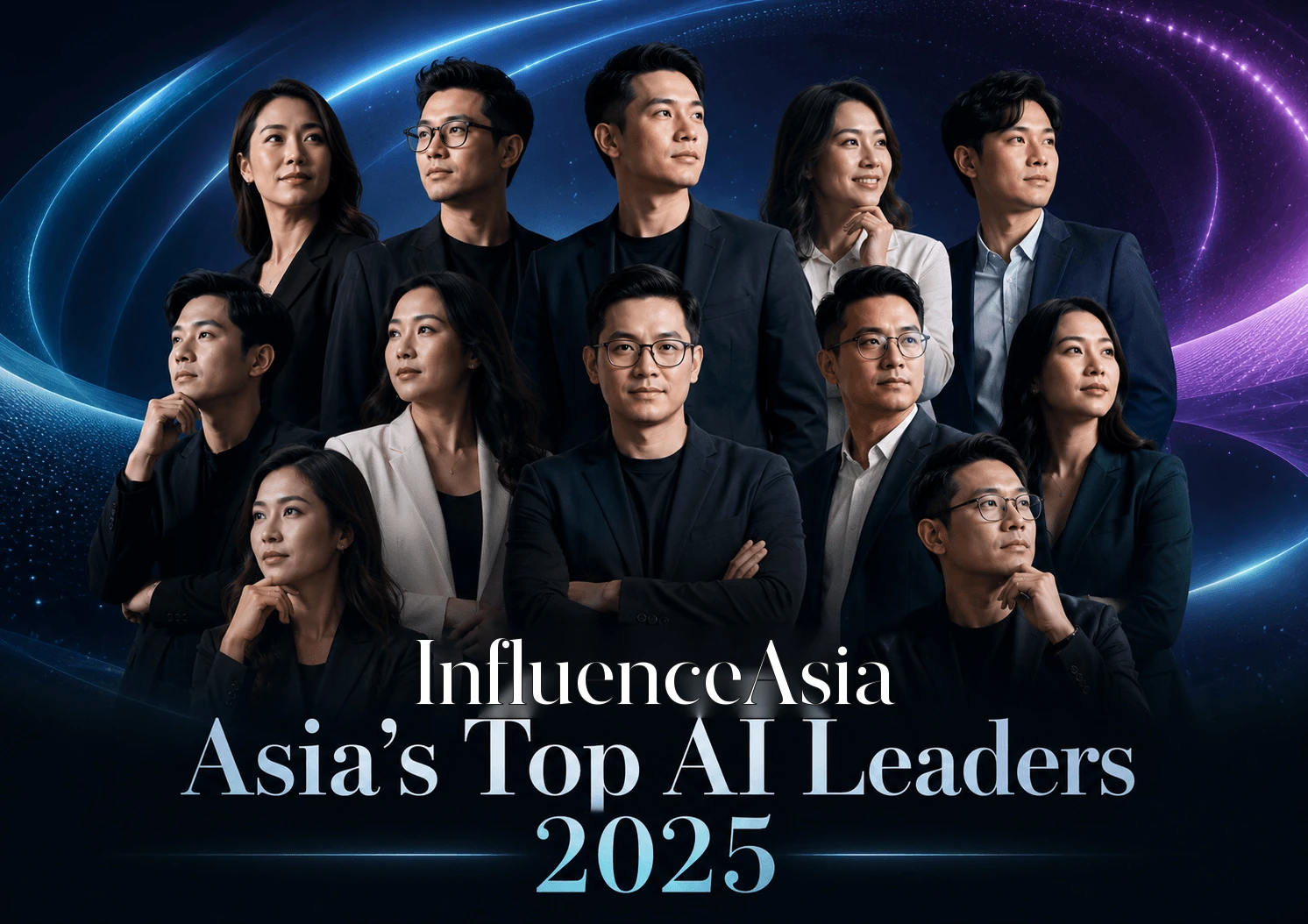
InfluenceAsia 2025 AI Leaders recognizes the Asian and Asian-diaspora figures whose work most meaningfully shaped artificial intelligence in 2025. The list emphasizes contribution rather than celebrity: model breakthroughs, compute infrastructure, open ecosystems, AI search, chips, agentic software, scientific AI, governance, education, and the institutional power required to move AI from demonstration to global utility.
Annual Thesis
The Architecture of Applied Intelligence
The 2025 edition is built around The Architecture of Applied Intelligence: the year when AI leadership was no longer defined only by model demos, but by the complete architecture of deployment, chips, clouds, data, agents, governance, scientific reasoning, and accessible products.
Strategic Reading
The architecture behind applied intelligence
InfluenceAsia places exceptional weight on leaders who changed the terms of the AI race: reducing model costs, scaling accelerators, moving AI into search and software work, building Asian foundation-model ecosystems, advancing responsible evaluation, and making AI a serious instrument for science, enterprise, and national infrastructure.
The strongest 2025 AI leaders combined technical literacy with institutional consequence. InfluenceAsia therefore ranks builders, researchers, CEOs, scientists, product architects, open-model leaders, governance figures, and infrastructure strategists on a shared contribution scale.
Top Ten
Leaders setting the 2025 AI agenda
The upper tier emphasizes contribution with visible field consequence: frontier models, AI infrastructure, AI search, semiconductors, scientific AI, open systems, and platform deployment.
Liang Wenfeng
DeepSeek-R1 made cost-efficient reasoning models the defining AI shock of 2025.
99.2Jensen Huang
NVIDIA remained the central hardware platform of the AI economy, with Huang setting the strategic language of accelerated intelligence.
98.8Demis Hassabis
Google DeepMind's leadership in Gemini, AlphaFold, and scientific AI kept Hassabis at the center of frontier research and deployment.
98.4Sundar Pichai
Google's 2025 Gemini strategy moved AI deeper into search, workspace, Android, cloud, and developer systems.
98.0Satya Nadella
Microsoft continued to industrialize AI through Azure, Copilot, enterprise platforms, and developer workflows.
97.6Fei-Fei Li
World Labs made spatial intelligence one of the year's most important next-frontier AI directions.
97.2Aravind Srinivas
Perplexity made AI-native search and answer interfaces a serious challenge to traditional discovery.
96.8Lisa Su
AMD's AI accelerator strategy made Su one of the most important non-NVIDIA infrastructure leaders.
96.4C.C. Wei
TSMC's manufacturing capacity remained a decisive foundation of the global AI compute supply chain.
96.0Masayoshi Son
SoftBank's AI infrastructure and chip-alliance strategy made Son a central capital architect of the 2025 AI buildout.
95.6Full Ranking
InfluenceAsia 2025 AI Leaders
A 50-entry InfluenceAsia editorial index with base, domain, annual signal, and AI Leadership Index score.
| Rank | Leader | Base | Primary domain | 2025 signal | Index |
|---|---|---|---|---|---|
| 01 | Liang WenfengFounder and CEO | China | Foundation models and open-weight AI | DeepSeek-R1 made cost-efficient reasoning models the defining AI shock of 2025. | 99.2 |
| 02 | Jensen HuangFounder and CEO | Taiwan / United States | AI infrastructure and accelerated computing | NVIDIA remained the central hardware platform of the AI economy, with Huang setting the strategic language of accelerated intelligence. | 98.8 |
| 03 | Demis HassabisResearch CEO | United Kingdom / Singaporean diaspora | Frontier AI and scientific AI | Google DeepMind's leadership in Gemini, AlphaFold, and scientific AI kept Hassabis at the center of frontier research and deployment. | 98.4 |
| 04 | Sundar PichaiPlatform CEO | India / United States | AI platforms and global product deployment | Google's 2025 Gemini strategy moved AI deeper into search, workspace, Android, cloud, and developer systems. | 98.0 |
| 05 | Satya NadellaPlatform CEO | India / United States | Enterprise AI and cloud platforms | Microsoft continued to industrialize AI through Azure, Copilot, enterprise platforms, and developer workflows. | 97.6 |
| 06 | Fei-Fei LiFounder and scientist | China / United States | Spatial intelligence and human-centered AI | World Labs made spatial intelligence one of the year's most important next-frontier AI directions. | 97.2 |
| 07 | Aravind SrinivasFounder and CEO | India / United States | AI search and answer engines | Perplexity made AI-native search and answer interfaces a serious challenge to traditional discovery. | 96.8 |
| 08 | Lisa SuCEO and engineer | Taiwan / United States | AI semiconductors and high-performance computing | AMD's AI accelerator strategy made Su one of the most important non-NVIDIA infrastructure leaders. | 96.4 |
| 09 | C.C. WeiSemiconductor CEO | Taiwan | Semiconductor manufacturing | TSMC's manufacturing capacity remained a decisive foundation of the global AI compute supply chain. | 96.0 |
| 10 | Masayoshi SonCapital and infrastructure leader | Japan | AI capital formation and infrastructure strategy | SoftBank's AI infrastructure and chip-alliance strategy made Son a central capital architect of the 2025 AI buildout. | 95.6 |
| 11 | Kai-Fu LeeFounder and ecosystem leader | Taiwan / China / United States | Chinese foundation models and AI entrepreneurship | 01.AI kept Lee prominent in China's efficient model and AI application ecosystem. | 95.2 |
| 12 | Alexandr WangFounder and AI executive | United States / Chinese diaspora | AI data infrastructure and superintelligence strategy | Wang's move from Scale AI into Meta's superintelligence leadership made him a major 2025 AI power figure. | 94.8 |
| 13 | Ashish VaswaniResearch founder | India / United States | Foundation model architecture and AI startups | A Transformer co-author and Essential AI co-founder, Vaswani remained central to the architecture lineage behind modern AI. | 94.4 |
| 14 | Lip-Bu TanSemiconductor CEO | Malaysia / United States | AI chips and semiconductor turnaround | His 2025 Intel appointment made him one of the most consequential leaders in the AI chip supply contest. | 94.0 |
| 15 | Mustafa SuleymanAI product CEO | United Kingdom / Syrian diaspora | Consumer AI and AI product strategy | Microsoft AI placed Suleyman at the center of Copilot, consumer AI, and applied AI direction. | 93.6 |
| 16 | Andrew NgEducator and entrepreneur | United States / Hong Kong diaspora | AI education, applied AI, and entrepreneurship | Ng continued to shape global AI literacy, applied AI adoption, and startup formation at massive scale. | 93.2 |
| 17 | Yejin ChoiResearch scientist | South Korea / United States | Reasoning, commonsense AI, and evaluation | Her work on commonsense, language, and trustworthy AI kept her among the field's leading research voices. | 92.8 |
| 18 | Anima AnandkumarResearch scientist | India / United States | Scientific AI and neural operators | Her work on AI for science and physical systems made her a defining 2025 scientific AI leader. | 92.4 |
| 19 | Rohit PrasadAI executive | India / United States | Agentic AI and consumer assistants | Amazon's AGI and Alexa transformation kept Prasad central to consumer-agent deployment. | 92.0 |
| 20 | Zhou JingrenCloud AI leader | China | Cloud AI and foundation models | Alibaba Cloud's Qwen and Wan ecosystems made Zhou one of China's key AI infrastructure leaders. | 91.6 |
| 21 | Yang ZhilinFounder and CEO | China | Chinese foundation models and AI agents | Moonshot AI and Kimi kept Yang central to China's long-context, agentic, and open-model competition. | 91.2 |
| 22 | Zhang PengCEO | China | Chinese foundation models and enterprise AI | Zhipu AI's GLM line and international rebranding as Z.ai made Zhang a major Chinese AI platform leader. | 90.8 |
| 23 | Wang XiaochuanFounder and CEO | China | Large language models and AI entrepreneurship | Baichuan kept Wang prominent in China's foundation-model startup ecosystem. | 90.4 |
| 24 | Robin LiFounder and CEO | China | Search, cloud AI, and Chinese AI platforms | Baidu's ERNIE ecosystem kept Li central to China's AI search, cloud, and application layer. | 90.0 |
| 25 | May HabibFounder and CEO | Lebanon / United States | Enterprise generative AI | Writer's enterprise AI platform made Habib one of the strongest West Asian-diaspora AI founders. | 89.6 |
| 26 | Rumman ChowdhuryGovernance founder | United States / Bangladeshi diaspora | Responsible AI and evaluation | Humane Intelligence and public-interest AI evaluation made Chowdhury a key governance leader. | 89.2 |
| 27 | Percy LiangResearch leader | United States / Chinese diaspora | Foundation model evaluation and research infrastructure | Stanford CRFM kept Liang central to evaluation, transparency, and foundation-model governance. | 88.8 |
| 28 | Dawn SongResearch scientist | China / United States | AI security, privacy, and trustworthy systems | Song remained a leading voice on secure, privacy-aware, and trustworthy AI infrastructure. | 88.4 |
| 29 | Soumith ChintalaOpen-source infrastructure leader | India / United States | Open-source AI infrastructure | PyTorch's continuing dominance kept Chintala's open-source infrastructure influence deeply relevant. | 88.0 |
| 30 | Quoc LeResearch scientist | Vietnam / United States | Machine learning research and model systems | His long-running Google research influence continued to shape large-scale learning and AutoML culture. | 87.6 |
| 31 | Aakanksha ChowdheryResearch leader | India / United States | Large language models and AI systems | Her leadership in PaLM-era model systems kept her central to Google's foundation-model lineage. | 87.2 |
| 32 | Niki ParmarResearch founder | India / United States | Foundation models and enterprise AI | A Transformer co-author and Essential AI co-founder, Parmar remained a major figure in AI architecture and applied systems. | 86.8 |
| 33 | Qiang YangResearch scientist | China / Hong Kong | Federated learning and AI research | Yang's work on federated learning and AI ecosystems kept him influential across academia and industry. | 86.4 |
| 34 | Pascale FungResearch scientist | Hong Kong | AI ethics, multilingual AI, and human-centered systems | Fung's work connected multilingual AI, ethics, and emotionally aware systems. | 86.0 |
| 35 | David HaFounder and research leader | Japan-based / United States | Generative AI research and AI startups | Sakana AI made Ha a leading figure in Japan's new model-company ecosystem. | 85.6 |
| 36 | Scott WuFounder and CEO | United States / Chinese diaspora | AI coding agents | Cognition and Devin made Wu one of the most visible leaders in autonomous software engineering. | 85.2 |
| 37 | Varun MohanFounder and product leader | India / United States | AI coding environments | Windsurf made Mohan a key 2025 figure in agentic development and AI-native software work. | 84.8 |
| 38 | Amit JainFounder and CEO | India / United States | Generative video and world models | Luma AI positioned Jain among the most important leaders in visual intelligence and AI video. | 84.4 |
| 39 | Demi GuoFounder | China / United States | Generative video | Pika kept Guo central to consumer-facing AI video creation and creative tooling. | 84.0 |
| 40 | Ivan ZhangFounder | Canada / Asian diaspora | Enterprise language models | Cohere's enterprise LLM work kept Zhang influential in applied foundation models. | 83.6 |
| 41 | Diyi YangResearch scientist | China / United States | NLP, social computing, and responsible AI | Yang's research linked language models, human behavior, and social impact. | 83.2 |
| 42 | Tatsunori HashimotoResearch scientist | Japan / United States | Foundation model evaluation and NLP | Hashimoto remained a strong technical voice in model reliability, data, and evaluation. | 82.8 |
| 43 | Jitendra MalikResearch scientist | India / United States | Computer vision and embodied AI | Malik's long-standing computer vision authority continued to shape AI perception and robotics. | 82.4 |
| 44 | Yi TayResearch scientist | Singapore / United States | Language models and AI architecture | Tay remained influential in large-model architecture, sequence modeling, and efficient AI systems. | 82.0 |
| 45 | Hyung Won ChungResearch scientist | South Korea / United States | Instruction tuning and language models | Chung's work on instruction-tuned systems remained part of the field's technical foundation. | 81.6 |
| 46 | Koray KavukcuogluResearch leader | Turkey / United Kingdom | Deep learning research leadership | DeepMind research leadership kept Kavukcuoglu important to frontier model development. | 81.2 |
| 47 | Sridhar RamaswamyCEO | India / United States | Data cloud and enterprise AI | Snowflake's AI data-cloud strategy made Ramaswamy a major enterprise AI leader. | 80.8 |
| 48 | Ali GhodsiCEO | Iran / United States | Data intelligence platforms | Databricks kept Ghodsi central to the data and AI application layer. | 80.4 |
| 49 | Vinod KhoslaInvestor and ecosystem builder | India / United States | AI venture strategy and ecosystem formation | Khosla's AI capital strategy remained influential in frontier AI company formation. | 80.0 |
| 50 | Yutaka MatsuoResearch and ecosystem leader | Japan | AI research, startups, and national ecosystem building | Matsuo remained a central figure in Japan's AI talent, research, and startup ecosystem. | 79.6 |
Research Dimensions
A weighted index for AI leadership
The index evaluates leadership across the AI stack rather than treating market value, citation volume, fame, or job title as a substitute for field contribution.
2025 Field Contribution
25 ptsThe leader's identifiable contribution to the AI field during 2025.
Model releases, product launches, infrastructure moves, governance frameworks, research breakthroughs, ecosystem creation, and public influence on AI direction.
Technical Authority
18 ptsThe depth of the leader's technical credibility or demonstrated command of AI systems.
Research record, engineering leadership, model architecture, computing systems, scientific AI, open-source tooling, and technical team direction.
Deployment Reach
17 ptsThe scale at which the leader's work reached users, developers, enterprises, governments, researchers, or infrastructure buyers.
Product adoption, cloud availability, developer usage, enterprise deployment, AI search reach, hardware adoption, and scientific or public-sector utility.
Infrastructure and Ecosystem Power
13 ptsThe leader's ability to shape the AI stack beyond a single product.
Chips, cloud, data pipelines, model ecosystems, open weights, developer platforms, investment architecture, and regional AI capacity.
Strategic Originality
10 ptsThe degree to which the leader changed assumptions in the field.
Cost reduction, new product category, new deployment model, non-Western model competitiveness, agentic workflow, or a new governance and evaluation practice.
Responsible Stewardship
9 ptsThe leader's contribution to safety, governance, evaluation, inclusion, security, or public accountability.
AI audits, evaluation methods, public-interest AI, policy work, multilingual access, privacy, safety culture, and risk framing.
Enduring Relevance
8 ptsThe probability that the leader's work will remain important beyond one news cycle.
Foundational research, durable infrastructure, institutional leadership, reusable technology, and long-term ecosystem formation.
Leader Dossiers
Profile record and InfluenceAsia rationale
Each dossier records the leader type, public leadership profile, and the editorial rationale used to position the entry within the 2025 edition.
Liang Wenfeng
Founder and CEO / China
ProfileLiang Wenfeng became the defining AI figure of 2025 through DeepSeek-R1. The model challenged assumptions about compute intensity, open-weight strategy, reasoning performance, and China's position in frontier AI.
InfluenceAsia rationaleInfluenceAsia ranks Liang first because his 2025 contribution changed the global AI conversation. DeepSeek forced labs, investors, governments, and cloud providers to reconsider cost curves, model openness, and competitive geography.
Jensen Huang
Founder and CEO / Taiwan / United States
ProfileJensen Huang remained the central infrastructure leader of the AI economy. NVIDIA's GPUs, networking, software stack, and systems strategy shaped the physical limits and commercial possibilities of large-scale AI.
InfluenceAsia rationaleInfluenceAsia ranks Huang second because AI in 2025 still ran through accelerated computing. His leadership turned semiconductors into the operating language of the AI era.
Demis Hassabis
Research CEO / United Kingdom / Singaporean diaspora
ProfileDemis Hassabis led Google DeepMind across frontier models, scientific AI, and the long arc from AlphaGo to AlphaFold and Gemini. His 2025 relevance combined research authority with platform deployment.
InfluenceAsia rationaleInfluenceAsia ranks Hassabis high because he embodies AI as science, product, and strategic research institution. His influence is unusually deep across both discovery and deployment.
Sundar Pichai
Platform CEO / India / United States
ProfileSundar Pichai directed Google's AI integration across Gemini, Search, Cloud, Workspace, Android, and developer tools. In 2025, Google framed AI less as a product line than as the company's operating layer.
InfluenceAsia rationaleInfluenceAsia places Pichai in the top tier because few leaders controlled AI deployment at comparable consumer, enterprise, and infrastructure scale.
Satya Nadella
Platform CEO / India / United States
ProfileSatya Nadella continued to transform Microsoft around AI through Azure, Copilot, GitHub, enterprise productivity, cloud infrastructure, and developer tooling.
InfluenceAsia rationaleInfluenceAsia ranks Nadella high because his leadership made generative AI an enterprise operating model, not only a research frontier.
Fei-Fei Li
Founder and scientist / China / United States
ProfileFei-Fei Li's World Labs placed spatial intelligence at the center of the next AI frontier. Her work connects visual understanding, embodied reasoning, human-centered AI, and the physical world.
InfluenceAsia rationaleInfluenceAsia includes Li near the top because she continues to define AI beyond text. Her 2025 contribution pointed toward systems that see, reason, and act in space.
Aravind Srinivas
Founder and CEO / India / United States
ProfileAravind Srinivas made Perplexity one of the strongest AI-native challenges to search. The company's answer engine, citation-led interface, and AI browser ambitions moved discovery into a new competitive frame.
InfluenceAsia rationaleInfluenceAsia ranks Srinivas highly because AI search is one of the clearest consumer behavior shifts of the year.
Lisa Su
CEO and engineer / Taiwan / United States
ProfileLisa Su led AMD's AI accelerator strategy and high-performance computing roadmap through a year of intense infrastructure demand.
InfluenceAsia rationaleInfluenceAsia includes Su because the AI hardware field needs credible alternatives to monopoly dynamics, and AMD's execution made her one of the indispensable compute leaders.
C.C. Wei
Semiconductor CEO / Taiwan
ProfileC.C. Wei led TSMC through a period when advanced manufacturing, packaging, and supply reliability became strategic foundations of AI.
InfluenceAsia rationaleInfluenceAsia ranks Wei because frontier AI depends on manufacturing excellence. His leadership sits beneath nearly every serious AI infrastructure discussion.
Masayoshi Son
Capital and infrastructure leader / Japan
ProfileMasayoshi Son's 2025 AI strategy centered on large-scale infrastructure, chips, investment, and the conviction that AI would become the defining industrial platform.
InfluenceAsia rationaleInfluenceAsia includes Son because capital architecture is part of AI leadership when it shapes compute supply, company formation, and ecosystem ambition.
Kai-Fu Lee
Founder and ecosystem leader / Taiwan / China / United States
ProfileKai-Fu Lee remained one of the most visible bridges between Chinese AI entrepreneurship, efficient model building, AI applications, and public interpretation of the field.
InfluenceAsia rationaleInfluenceAsia ranks Lee because he combines technical history, investment discipline, founder leadership, and China-US AI literacy.
Alexandr Wang
Founder and AI executive / United States / Chinese diaspora
ProfileAlexandr Wang's 2025 move into Meta's superintelligence leadership made him one of the youngest and most consequential executives in the AI race.
InfluenceAsia rationaleInfluenceAsia includes Wang because data infrastructure, evaluation, and frontier-lab organization became central to AI competitiveness.
Ashish Vaswani
Research founder / India / United States
ProfileAshish Vaswani's influence begins with the Transformer architecture and continued through Essential AI's work on enterprise AI agents and model systems.
InfluenceAsia rationaleInfluenceAsia ranks him as a foundational architecture leader whose work remains embedded in nearly every modern AI system.
Lip-Bu Tan
Semiconductor CEO / Malaysia / United States
ProfileLip-Bu Tan's 2025 appointment to lead Intel placed him at the center of a critical AI infrastructure turnaround.
InfluenceAsia rationaleInfluenceAsia includes Tan because AI leadership depends on foundries, packaging, accelerators, design tools, and supply-chain execution, not only model labs.
Mustafa Suleyman
AI product CEO / United Kingdom / Syrian diaspora
ProfileMustafa Suleyman led Microsoft AI across Copilot and consumer-facing applied AI, bringing a DeepMind and Inflection pedigree into one of the world's largest AI distribution systems.
InfluenceAsia rationaleInfluenceAsia ranks him because product philosophy, safety framing, and consumer AI experience became decisive in 2025.
Andrew Ng
Educator and entrepreneur / United States / Hong Kong diaspora
ProfileAndrew Ng continued to shape the global AI workforce through education, applied AI companies, technical evangelism, and practical deployment frameworks.
InfluenceAsia rationaleInfluenceAsia includes Ng because durable field influence is measured by talent formation as well as products.
Yejin Choi
Research scientist / South Korea / United States
ProfileYejin Choi's work on commonsense reasoning, language, and trustworthy AI remained central to technical debates about what current models understand and fail to understand.
InfluenceAsia rationaleInfluenceAsia ranks her because AI progress requires a deeper account of reasoning, knowledge, bias, and evaluation.
Anima Anandkumar
Research scientist / India / United States
ProfileAnima Anandkumar's neural-operator and scientific AI work connected machine learning to weather, physics, engineering, and multiscale systems.
InfluenceAsia rationaleInfluenceAsia includes her because scientific AI is one of the strongest routes from generative excitement to real-world problem solving.
Rohit Prasad
AI executive / India / United States
ProfileRohit Prasad remained central to Amazon's AGI and Alexa transformation, where consumer agents, speech interfaces, and multimodal assistance converged.
InfluenceAsia rationaleInfluenceAsia ranks Prasad because AI assistants require deep product, speech, and infrastructure integration to move beyond demos.
Zhou Jingren
Cloud AI leader / China
ProfileZhou Jingren led Alibaba Cloud's foundation-model development across Qwen, Wan, and enterprise AI applications.
InfluenceAsia rationaleInfluenceAsia includes Zhou because Qwen became one of Asia's most important open and cloud-distributed model ecosystems.
Yang Zhilin
Founder and CEO / China
ProfileYang Zhilin's Moonshot AI and Kimi products kept him central to China's long-context, agentic, and open-model competition.
InfluenceAsia rationaleInfluenceAsia ranks Yang because China's model ecosystem in 2025 was not a single-company story, and Moonshot remained a critical challenger.
Zhang Peng
CEO / China
ProfileZhang Peng led Zhipu AI as it advanced the GLM family, enterprise adoption, and international identity under the Z.ai brand.
InfluenceAsia rationaleInfluenceAsia includes Zhang because Z.ai became a major Chinese open-model and enterprise AI contender.
Wang Xiaochuan
Founder and CEO / China
ProfileWang Xiaochuan's Baichuan continued to represent China's foundation-model startup wave, informed by his earlier search and language-technology career.
InfluenceAsia rationaleInfluenceAsia ranks Wang because China's AI field relies on experienced founders who understand both consumer distribution and model development.
Robin Li
Founder and CEO / China
ProfileRobin Li kept Baidu central to China's AI application layer through ERNIE, cloud AI, search, and enterprise deployment.
InfluenceAsia rationaleInfluenceAsia includes Li because search, cloud, and LLM integration remain core to China's domestic AI ecosystem.
May Habib
Founder and CEO / Lebanon / United States
ProfileMay Habib built Writer into one of the most important enterprise generative AI companies, focusing on brand-safe, workflow-aware, and enterprise-ready models.
InfluenceAsia rationaleInfluenceAsia ranks Habib because enterprise AI adoption requires trust, governance, and operational integration, not only raw model scale.
Rumman Chowdhury
Governance founder / United States / Bangladeshi diaspora
ProfileRumman Chowdhury's Humane Intelligence work kept independent AI evaluation, public-interest testing, and responsible deployment in the foreground.
InfluenceAsia rationaleInfluenceAsia includes Chowdhury because AI governance became practical and operational in 2025, not merely philosophical.
Percy Liang
Research leader / United States / Chinese diaspora
ProfilePercy Liang's work through Stanford CRFM continued to shape foundation-model evaluation, transparency, benchmarking, and governance research.
InfluenceAsia rationaleInfluenceAsia ranks Liang because the field needs rigorous public infrastructure for understanding model capabilities and risks.
Dawn Song
Research scientist / China / United States
ProfileDawn Song remained a key figure in AI security, privacy, trustworthy systems, and the technical foundations of safer deployment.
InfluenceAsia rationaleInfluenceAsia includes Song because security and privacy determine whether AI can be trusted in high-stakes environments.
Soumith Chintala
Open-source infrastructure leader / India / United States
ProfileSoumith Chintala's PyTorch legacy remained one of the deepest pieces of AI infrastructure in 2025, powering research and production across the field.
InfluenceAsia rationaleInfluenceAsia ranks him because open-source tools create the practical ground on which AI ecosystems are built.
Quoc Le
Research scientist / Vietnam / United States
ProfileQuoc Le's work across large-scale learning, AutoML, and model systems remained part of Google's deep technical AI lineage.
InfluenceAsia rationaleInfluenceAsia includes him because model progress is cumulative, and his research shaped many of the systems that followed.
Aakanksha Chowdhery
Research leader / India / United States
ProfileAakanksha Chowdhery's large-model work helped define the PaLM-era lineage of language models and their transition into broader product systems.
InfluenceAsia rationaleInfluenceAsia ranks her because large model building requires technical leadership across data, architecture, scaling, and evaluation.
Niki Parmar
Research founder / India / United States
ProfileNiki Parmar's Transformer authorship and Essential AI work kept her relevant to both the history and application of foundation models.
InfluenceAsia rationaleInfluenceAsia includes her because core architecture contributors remain central when their ideas become industry infrastructure.
Qiang Yang
Research scientist / China / Hong Kong
ProfileQiang Yang continued to influence federated learning, privacy-aware AI, and cross-institutional AI research in Asia and globally.
InfluenceAsia rationaleInfluenceAsia ranks him because the next stage of AI requires learning across distributed data without simple centralization.
Pascale Fung
Research scientist / Hong Kong
ProfilePascale Fung's work on multilingual, ethical, and emotionally aware AI systems remained important to human-centered deployment.
InfluenceAsia rationaleInfluenceAsia includes her because AI systems must operate across languages, cultures, and social contexts.
David Ha
Founder and research leader / Japan-based / United States
ProfileDavid Ha's Sakana AI represented a Japan-based model-company path built around nature-inspired AI and new research culture.
InfluenceAsia rationaleInfluenceAsia ranks him because Japan's AI ecosystem gained a globally visible startup identity through Sakana.
Scott Wu
Founder and CEO / United States / Chinese diaspora
ProfileScott Wu's Cognition and Devin helped define the AI coding-agent debate, turning software engineering into one of the most contested automation frontiers.
InfluenceAsia rationaleInfluenceAsia includes him because agentic software work became one of the clearest 2025 AI product categories.
Varun Mohan
Founder and product leader / India / United States
ProfileVarun Mohan's Windsurf work made AI-native development environments a central part of the coding-agent wave.
InfluenceAsia rationaleInfluenceAsia ranks him because developer tools are where AI moves from suggestion to workflow transformation.
Amit Jain
Founder and CEO / India / United States
ProfileAmit Jain's Luma AI helped push generative video, visual intelligence, and world-model thinking into the creative AI mainstream.
InfluenceAsia rationaleInfluenceAsia includes him because multimodal AI became one of the year's most important creative frontiers.
Demi Guo
Founder / China / United States
ProfileDemi Guo's Pika remained one of the most visible AI video creation platforms, giving creators consumer-facing access to generative video tools.
InfluenceAsia rationaleInfluenceAsia ranks her because video generation changed who could produce motion imagery and how quickly visual ideas could be tested.
Ivan Zhang
Founder / Canada / Asian diaspora
ProfileIvan Zhang's work with Cohere contributed to enterprise-ready language models focused on business deployment, security, and reliability.
InfluenceAsia rationaleInfluenceAsia includes him because enterprise LLM adoption became a decisive layer of the AI market.
Diyi Yang
Research scientist / China / United States
ProfileDiyi Yang connected NLP, social computing, human behavior, and responsible AI, making her work important to how models operate in society.
InfluenceAsia rationaleInfluenceAsia ranks her because AI increasingly mediates social interaction, not only content generation.
Tatsunori Hashimoto
Research scientist / Japan / United States
ProfileTatsunori Hashimoto's research on foundation model reliability, data, robustness, and evaluation remained highly relevant in 2025.
InfluenceAsia rationaleInfluenceAsia includes him because evaluation and failure analysis define the useful boundary of AI systems.
Jitendra Malik
Research scientist / India / United States
ProfileJitendra Malik's long-standing computer vision influence continued to shape perception, robotics, embodied AI, and visual reasoning.
InfluenceAsia rationaleInfluenceAsia ranks him because AI's future requires systems that see and act, not only systems that write.
Yi Tay
Research scientist / Singapore / United States
ProfileYi Tay's work on efficient architectures, sequence modeling, and large language systems contributed to the technical understanding of scale and efficiency.
InfluenceAsia rationaleInfluenceAsia includes him because efficient model design became strategically important in 2025.
Hyung Won Chung
Research scientist / South Korea / United States
ProfileHyung Won Chung's instruction-tuning work helped shape the practical behavior of modern language models.
InfluenceAsia rationaleInfluenceAsia ranks him because instruction following remains a foundation of usable AI.
Koray Kavukcuoglu
Research leader / Turkey / United Kingdom
ProfileKoray Kavukcuoglu's leadership within Google DeepMind kept him close to frontier model research and the institutional direction of advanced AI.
InfluenceAsia rationaleInfluenceAsia includes him because research leadership is field-shaping when it directs large technical organizations.
Sridhar Ramaswamy
CEO / India / United States
ProfileSridhar Ramaswamy led Snowflake through a period when data clouds and AI-native analytics became inseparable.
InfluenceAsia rationaleInfluenceAsia ranks him because enterprise AI depends on governed data as much as model access.
Ali Ghodsi
CEO / Iran / United States
ProfileAli Ghodsi's Databricks remained central to data intelligence, lakehouse architecture, and AI application deployment.
InfluenceAsia rationaleInfluenceAsia includes him because the data layer is a decisive part of the AI stack.
Vinod Khosla
Investor and ecosystem builder / India / United States
ProfileVinod Khosla's AI investment strategy continued to shape frontier company formation, risk appetite, and long-term AI market conviction.
InfluenceAsia rationaleInfluenceAsia ranks him because capital can be field-shaping when it backs technical ambition before consensus forms.
Yutaka Matsuo
Research and ecosystem leader / Japan
ProfileYutaka Matsuo remained one of Japan's most important AI ecosystem builders through research, startup formation, education, and policy influence.
InfluenceAsia rationaleInfluenceAsia includes him because national AI capacity depends on talent systems and institutional leadership, not only individual products.
Editorial Method
Selection system, eligibility gate, and publication authority
InfluenceAsia controls the selection framework, evidence interpretation, index structure, written analysis, ranking order, rights posture, and final publication language for this edition.
Scoring System
How the ranking is formed
- 01Ranking model
InfluenceAsia applied a 100-point editorial research model across seven dimensions: 2025 Field Contribution, Technical Authority, Deployment Reach, Infrastructure and Ecosystem Power, Strategic Originality, Responsible Stewardship, and Enduring Relevance.
- 02Evaluation period
The editorial record was assessed through 31 December 2025. Later achievements are not used as ranking evidence in this edition.
- 03Contribution screen
High placement requires a clear AI-specific 2025 contribution: a model release, platform shift, infrastructure decision, governance practice, scientific breakthrough, agentic workflow, open-source system, deployment milestone, or ecosystem-level impact.
- 04Evidence type
Review considered public product releases, research record, institutional role, model and platform influence, infrastructure relevance, open-source contribution, governance work, developer adoption, enterprise deployment, and strategic field impact.
- 05Comparability rule
The list compares different forms of AI leadership by normalizing each leader first within their own domain, then across the full AI stack. A chip leader, research scientist, founder, and governance expert are not measured by identical metrics.
- 06Current-year rule
A major 2025 contribution carries substantial weight. Enduring leaders remain eligible when their 2025 role was materially active and internationally legible.
- 07Integrity rule
InfluenceAsia excludes unverified founders, purely promotional figures, non-AI executives, anonymous accounts, and leaders whose AI relevance is only speculative.
- 08Editorial judgment
Final placement reflects InfluenceAsia's independent editorial judgment after research normalization. The index is not a market-cap ranking, revenue ranking, citation ranking, funding ranking, or endorsement product.
Eligibility Gate
Who can be ranked
- Asian connectionLeaders may be born in Asia, professionally anchored in Asia, of Asian heritage, or central to an Asian AI ecosystem with international consequence.
- Activity windowLeaders must have material AI presence by 2025, with strong weighting for 2025 releases, appointments, technical breakthroughs, infrastructure decisions, platform adoption, public governance work, or ecosystem-level influence.
- Field scopeEligible fields include machine learning research, large language models, AI chips, cloud infrastructure, AI search, coding agents, multimodal AI, scientific AI, robotics, AI safety, data infrastructure, AI education, open-source systems, and governance.
- ExclusionsThe list excludes leaders whose relevance is purely financial, purely political, anonymous, unverifiable, or unrelated to AI field contribution.
- Institution ruleCorporate leaders are eligible when their 2025 AI decisions materially shaped products, infrastructure, market direction, or developer ecosystems.
- Research ruleResearchers are eligible when their work materially influenced foundation models, evaluation, scientific discovery, open research, alignment, data, language, robotics, or the technical understanding of AI systems.
Rights & Enforcement
Original InfluenceAsia ranking. All rights reserved.
- Original ranking authorityInfluenceAsia 2025 AI Leaders is an original InfluenceAsia editorial and research ranking. InfluenceAsia reserves all rights in the ranking structure, ordering logic, annual thesis, research dimensions, written summaries, scoring interpretation, page presentation, and publication language.
- Controlled publication useNo reproduction, scraping, republication, mirroring, translation, commercial reuse, database extraction, training-data use, derivative ranking use, or removal of InfluenceAsia attribution is permitted without prior written authorization from InfluenceAsia.
- Enforcement noticeUnauthorized use, deceptive republication, automated extraction, misattribution, commercial reuse, or derivative publication may be pursued through takedown notices, platform complaints, legal demand letters, injunctions, damages claims, and any other remedies available to InfluenceAsia.
- Identification of third partiesNames, company names, academic affiliations, product names, model names, and public career descriptors are used for identification, editorial commentary, and technology analysis. Rights in third-party names, marks, products, research papers, patents, and institutional identities remain with their respective owners.
- No commercial affiliationInclusion does not create or imply endorsement, sponsorship, employment relationship, partnership, certification, investment recommendation, procurement advice, or commercial affiliation between InfluenceAsia and any listed person, company, university, laboratory, foundation, investor, product, or rights holder.
- Editorial statusThis edition is technology leadership analysis and editorial judgment prepared from the 2025 publication perspective. InfluenceAsia may revise, correct, expand, archive, enforce, or withdraw publication assets at its discretion.
- Rights reservedAll rights not expressly granted in writing by InfluenceAsia are reserved.