Influence is treated as the ability to move institutions, markets, ideas or publics at scale, not simply visibility or office.
2016
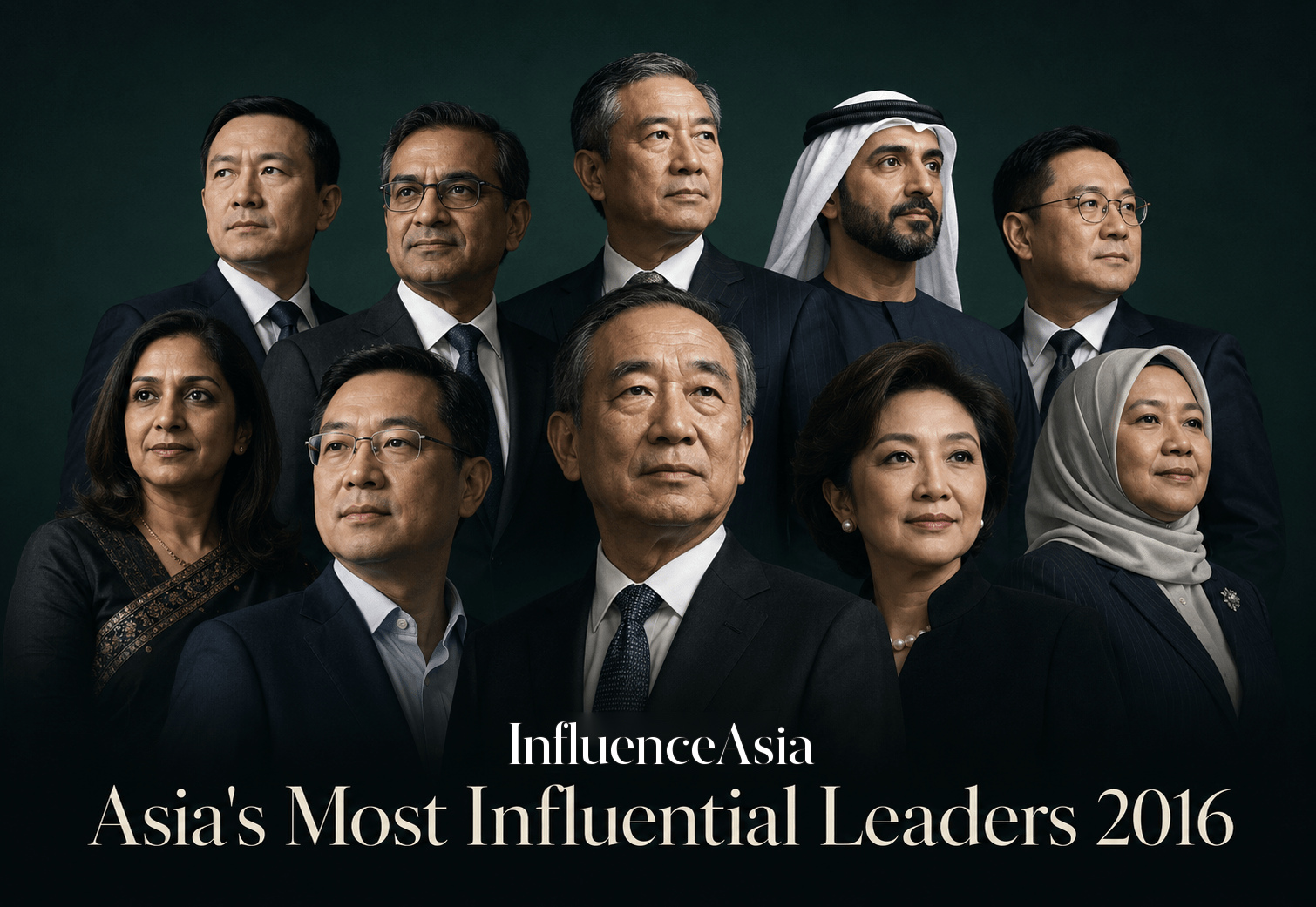
Asia's Most Influential Leaders 2016
An editorial ranking of the leaders who shaped Asia's institutions, markets, ideas and public life in 2016.
97Leaders Ranked
100Point Influence Index
7Research Dimensions
36Market Bases
Ranking Introduction
The Year Asia Rewired Authority
The leaders who shaped Asia’s institutions, markets, ideas and public life in 2016.
The 2016 edition treats influence as the ability to move institutions, markets, ideas or publics at scale. The strongest leaders in this list did over hold visible positions; they changed the direction of economies, built platforms, shaped diplomacy, expanded public access, advanced science, enlarged cultural imagination or altered the operating logic of their fields.
In 2016, Asian leadership was shaped by structural transition. China consolidated political authority. India pushed digital and financial formalization. Japan continued monetary and strategic experimentation. Southeast Asia accelerated infrastructure and urban reform. The Gulf began a new diversification narrative. Asian technology platforms matured into global forces. Science, culture and civil society gave the region a wider moral and intellectual presence.
InfluenceAsia publishes this ranking as independent editorial analysis. The list, scoring architecture, placement logic, written profiles and presentation language are controlled by InfluenceAsia. Inclusion does not imply endorsement by the leaders, governments, companies, institutions, voters, shareholders, citizens, employees, foundations, regulators or communities named or implied. It is not a wealth list, traffic ranking or advertising award; it is an independent InfluenceAsia research and editorial ranking.
The ranking is written from the 2016 editorial standpoint and does not rely on subsequent outcomes or hindsight.
Selection, order, scoring and written profiles are controlled by InfluenceAsia as an original editorial product.
Representative Cases
Eight Leaders That Define The 2016 Thesis
#01
Narendra Modi
Governance, Digital Statecraft and Economic Reform
Modi is ranked second for placing India's state capacity, digital ambition and economic formalization at the center of the 2016 Asian agenda.
#02
Shinzo Abe
Economic Strategy and Security Policy
Abe is included for sustaining Japan's most consequential political project of the decade.
#03
Joko Widodo
Infrastructure, Reform and Democratic Governance
Widodo ranks fourth for making infrastructure and pragmatic reform the language of Indonesia's national development.
#04
Lee Hsien Loong
Governance, Strategy and Regional Stability
Lee is ranked for steering Singapore through a demanding post-founding era with institutional continuity and strategic precision.
#05
Jack Ma
E-Commerce, Digital Platforms and Entrepreneurship
Ma is included for making Alibaba one of Asia's defining business platforms.
#06
Mukesh Ambani
Telecoms, Energy and Digital Infrastructure
Ambani is ranked for launching Jio as a national-scale digital infrastructure bet.
#07
Masayoshi Son
Technology Investment and Strategic Capital
Son is included for using SoftBank's balance sheet to pursue a global technology thesis.
#08
Sheikh Mohammed bin Rashid Al Maktoum
Urban Leadership, Government Innovation and Global City Building
Sheikh Mohammed is ranked for turning Dubai into a global reference point for logistics, aviation, finance, tourism and public-sector innovation.
Full Ranking
The Full List
Showing 97 leaders
| Rank | Leader | Platform | Market Base | Primary Sector | Index | Signal |
|---|---|---|---|---|---|---|
| 1 | Narendra ModiGovernance, Digital Statecraft and Economic Reform | Government of India | India | Governance | 99.2 | Modi is ranked second for placing India's state capacity, digital ambition and economic formalization at the center of the 2016 Asian agenda. |
| 2 | Shinzo AbeEconomic Strategy and Security Policy | Government of Japan | Japan | Governance | 98.9 | Abe is included for sustaining Japan's most consequential political project of the decade. |
| 3 | Joko WidodoInfrastructure, Reform and Democratic Governance | Government of Indonesia | Indonesia | Governance | 98.6 | Widodo ranks fourth for making infrastructure and pragmatic reform the language of Indonesia's national development. |
| 4 | Lee Hsien LoongGovernance, Strategy and Regional Stability | Government of Singapore | Singapore | Governance | 98.3 | Lee is ranked for steering Singapore through a demanding post-founding era with institutional continuity and strategic precision. |
| 5 | Jack MaE-Commerce, Digital Platforms and Entrepreneurship | Alibaba | China | Technology | 98.0 | Ma is included for making Alibaba one of Asia's defining business platforms. |
| 6 | Mukesh AmbaniTelecoms, Energy and Digital Infrastructure | Reliance Industries / Jio | India | Technology | 97.7 | Ambani is ranked for launching Jio as a national-scale digital infrastructure bet. |
| 7 | Masayoshi SonTechnology Investment and Strategic Capital | SoftBank Group | Japan | Finance | 97.4 | Son is included for using SoftBank's balance sheet to pursue a global technology thesis. |
| 8 | Sheikh Mohammed bin Rashid Al MaktoumUrban Leadership, Government Innovation and Global City Building | Dubai government | United Arab Emirates | Governance | 97.1 | Sheikh Mohammed is ranked for turning Dubai into a global reference point for logistics, aviation, finance, tourism and public-sector innovation. |
| 9 | Tsai Ing-wenDemocratic Leadership and Cross-Strait Governance | Government of Taiwan | Taiwan | Governance | 96.8 | Tsai is included for her 2016 inauguration as Taiwan's first woman president and for assuming leadership at a sensitive cross-strait moment. |
| 10 | Aung San Suu KyiDemocratic Transition and National Reconciliation | Myanmar civilian leadership | Myanmar | Leadership | 96.5 | Aung San Suu Kyi is ranked for entering government leadership after Myanmar's landmark electoral transition. |
| 11 | Recep Tayyip ErdoganState Leadership and Regional Security | Government of Turkey | Turkey | Governance | 96.2 | Erdogan is included for his decisive role in Turkey's domestic and regional direction during a volatile year. |
| 12 | Ma HuatengSocial Platforms, Gaming and Digital Services | Tencent | China | Technology | 95.9 | Ma Huateng is ranked for building Tencent into one of Asia's most important digital ecosystems. |
| 13 | Ren ZhengfeiTelecommunications and Strategic Technology | Huawei | China | Technology | 95.6 | Ren is included for leading Huawei as a global telecommunications and device company with deep engineering discipline. |
| 14 | Haruhiko KurodaCentral Banking and Monetary Policy | Bank of Japan | Japan | Finance | 95.3 | Kuroda is ranked for operating at the frontier of monetary policy. |
| 15 | Raghuram RajanCentral Banking and Financial Stability | Reserve Bank of India | India | Finance | 94.7 | Rajan is ranked for completing a highly respected term at the Reserve Bank of India in 2016. |
| 16 | Ban Ki-moonMultilateral Diplomacy and Global Governance | United Nations | South Korea / United Nations | Governance | 94.4 | Ban is included for concluding his decade as United Nations Secretary-General in 2016. |
| 17 | Mohammed bin SalmanEconomic Transformation and State Strategy | Saudi Vision 2030 | Saudi Arabia | Governance | 94.1 | Mohammed bin Salman is ranked for making 2016 the year Saudi Arabia's long-term transformation agenda entered global consciousness. |
| 18 | King Salman bin Abdulaziz Al SaudMonarchy, Energy and Regional Leadership | Kingdom of Saudi Arabia | Saudi Arabia | Governance | 93.8 | King Salman is included for leading Saudi Arabia during a period of fiscal pressure, oil-market change and regional security strain. |
| 19 | Ali KhameneiSupreme Leadership and Regional Strategy | Iranian supreme leadership | Iran | Leadership | 93.5 | Khamenei is ranked for his unmatched influence over Iran's political, security and ideological direction. |
| 20 | Hassan RouhaniDiplomacy, Economic Opening and Governance | Government of Iran | Iran | Governance | 93.2 | Rouhani is included for managing Iran's post-nuclear-agreement opening and domestic policy expectations. |
| 21 | Benjamin NetanyahuSecurity, Diplomacy and Innovation Economy | Government of Israel | Israel | Governance | 92.9 | Netanyahu is ranked for his role in Israeli security strategy, diplomacy and the global positioning of Israel's technology economy. |
| 22 | Mohammed bin Zayed Al NahyanSecurity Strategy and State Modernization | Abu Dhabi / UAE state leadership | United Arab Emirates | Governance | 92.6 | Mohammed bin Zayed is included for his influence over Abu Dhabi's strategic direction and the UAE's regional posture. |
| 23 | Sheikh HasinaDevelopment Governance and Social Progress | Government of Bangladesh | Bangladesh | Governance | 92.3 | Sheikh Hasina is ranked for leading Bangladesh through a period of growth, social improvement and infrastructure ambition. |
| 24 | Sheikh Tamim bin Hamad Al ThaniEnergy Statecraft and Global Investment | State of Qatar | Qatar | Governance | 92.0 | Sheikh Tamim is included for guiding Qatar's gas wealth, diplomatic posture and global investment profile. |
| 25 | Rodrigo DuterteNational Politics and Foreign Policy Reorientation | Government of the Philippines | Philippines | Leadership | 91.7 | Duterte is ranked for the immediate and disruptive force of his 2016 election. |
| 26 | Najib RazakGovernment, Regional Economics and ASEAN Leadership | Government of Malaysia | Malaysia | Governance | 91.4 | Najib is included for leading Malaysia at the intersection of ASEAN diplomacy, infrastructure finance, Islamic finance and domestic political pressure. |
| 27 | Prayuth Chan-o-chaState Governance and Political Transition | Government of Thailand | Thailand | Governance | 91.1 | Prayuth is ranked for steering Thailand under military-led governance during a constitution-making period. |
| 28 | Nawaz SharifEconomic Corridor Strategy and Democratic Governance | Government of Pakistan | Pakistan | Governance | 90.8 | Sharif is included for his role in Pakistan's infrastructure and energy agenda, particularly the China-Pakistan Economic Corridor. |
| 29 | Ashraf GhaniState-Building and Reform Governance | Government of Afghanistan | Afghanistan | Governance | 90.5 | Ghani is ranked for leading Afghanistan through a fragile reform and security environment. |
| 30 | Haider al-AbadiSecurity Leadership and State Stabilization | Government of Iraq | Iraq | Governance | 90.2 | Al-Abadi is included for leading Iraq through a decisive security and governance year. |
| 31 | Abdullah IIDiplomacy, Security and Regional Stability | Hashemite Kingdom of Jordan | Jordan | Governance | 89.9 | Abdullah II is ranked for Jordan's stabilizing role in a turbulent region. |
| 32 | Jin LiqunMultilateral Finance and Infrastructure | Asian Infrastructure Investment Bank | China / Asia | Finance | 89.6 | Jin is included for becoming the inaugural president of the Asian Infrastructure Investment Bank in 2016. |
| 33 | Takehiko NakaoDevelopment Finance and Regional Policy | Asian Development Bank | Japan / Asia-Pacific | Finance | 89.3 | Nakao is ranked for leading the Asian Development Bank during a period of rising infrastructure demand and institutional competition. |
| 34 | Sri Mulyani IndrawatiPublic Finance and Economic Governance | Indonesia Ministry of Finance | Indonesia | Governance | 89.0 | Sri Mulyani is included for returning to Indonesia's finance ministry in 2016 with international credibility and reform authority. |
| 35 | Tharman ShanmugaratnamEconomic Policy and Global Governance | Singapore economic leadership | Singapore | Governance | 88.7 | Tharman is ranked for combining Singaporean economic stewardship with international policy influence. |
| 36 | Ho ChingSovereign Investment and Corporate Stewardship | Temasek | Singapore | Finance | 88.4 | Ho is included for leading Temasek as one of Asia's most influential investment institutions. |
| 37 | Robin LiSearch, AI and Internet Platforms | Baidu | China | Technology | 88.1 | Li is ranked for leading Baidu through China's shift from search toward artificial intelligence, maps, mobile services and autonomous technologies. |
| 38 | Lei JunConsumer Technology and Hardware Ecosystems | Xiaomi | China | Technology | 87.8 | Lei is included for building Xiaomi into a symbol of Chinese consumer-technology ambition. |
| 39 | Akio ToyodaAutomotive Leadership and Mobility Strategy | Toyota | Japan | Technology | 87.5 | Toyoda is ranked for leading the world's most important Japanese industrial brand through a transition toward cleaner, safer and more connected mobility. |
| 40 | Morris ChangSemiconductors and Foundry Architecture | TSMC | Taiwan / Global | Technology | 87.2 | Chang is included for his continuing influence over the semiconductor foundry model. |
| 41 | Terry GouElectronics Manufacturing and Supply Chains | Foxconn | Taiwan / Global | Technology | 86.9 | Gou is ranked for leading Foxconn at the center of global electronics production. |
| 42 | Lee Jae-yongConglomerate Leadership and Technology Strategy | Samsung | South Korea | Technology | 86.6 | Lee is included for his rising role in Samsung's strategic direction during a difficult year for the group. |
| 43 | Kwon Oh-hyunSemiconductors and Advanced Electronics | Samsung Electronics | South Korea | Technology | 86.3 | Kwon is ranked for leadership in Samsung Electronics' components and device-technology strength. |
| 44 | Wang JianlinReal Estate, Entertainment and Global Consumer Assets | Dalian Wanda | China | Governance | 86.0 | Wang is included for Dalian Wanda's aggressive move from property into entertainment, film, sport and global consumer assets. |
| 45 | Li Ka-shingConglomerates, Ports and Long-Horizon Capital | CK Hutchison | Hong Kong / Global | Finance | 85.7 | Li is ranked for enduring influence over ports, infrastructure, telecoms, retail and global investment through CK Hutchison and related holdings. |
| 46 | Tadashi YanaiRetail, Apparel and Global Brand Building | Fast Retailing / Uniqlo | Japan | Technology | 85.4 | Yanai is included for building Fast Retailing and Uniqlo into a global Japanese retail force. |
| 47 | Ratan TataIndustrial Stewardship and Corporate Governance | Tata Group | India | Governance | 85.1 | Tata is ranked for his enduring influence over one of India's most respected business houses. |
| 48 | N. ChandrasekaranTechnology Services and Enterprise Leadership | Tata Consultancy Services | India | Technology | 84.8 | Chandrasekaran is included for leading Tata Consultancy Services as India's flagship technology-services company. |
| 49 | Azim PremjiTechnology Services and Philanthropic Leadership | Wipro / Azim Premji Foundation | India | Technology | 84.5 | Premji is ranked for combining Wipro's technology-services heritage with one of Asia's most important philanthropic commitments. |
| 50 | Kiran Mazumdar-ShawBiotechnology and Entrepreneurial Science | Biocon | India | Technology | 84.2 | Mazumdar-Shaw is included for making Biocon a symbol of Indian biotechnology ambition. |
| 51 | Arundhati BhattacharyaPublic Banking and Financial Inclusion | State Bank of India | India | Finance | 83.9 | Bhattacharya is ranked for leading State Bank of India at exceptional scale. |
| 52 | Chanda KochharPrivate Banking and Consumer Finance | ICICI Bank | India | Finance | 83.6 | Kochhar is included for leading ICICI Bank, one of India's most visible private-sector financial institutions. |
| 53 | Uday KotakBanking, Capital Markets and Financial Entrepreneurship | Kotak Mahindra Bank | India | Finance | 83.3 | Kotak is ranked for building a conservative, high-trust financial institution around banking, capital markets, wealth and insurance. |
| 54 | Nandan NilekaniDigital Public Infrastructure and Technology Leadership | Digital Public Infrastructure and Technology Leadership | India | Technology | 83.0 | Nilekani is included for his continuing influence on India's digital identity and public-technology architecture. |
| 55 | Vijay Shekhar SharmaDigital Payments and Fintech | Paytm | India | Finance | 82.7 | Sharma is ranked for building Paytm into a national digital-payments platform at a decisive moment. |
| 56 | Cheng WeiMobility Platforms and Consumer Internet | Didi Chuxing | China | Technology | 82.4 | Cheng is included for leading Didi Chuxing through a defining 2016 consolidation of China's ride-hailing market. |
| 57 | Jean LiuTechnology Operations and Mobility Leadership | Didi Chuxing | China | Technology | 82.1 | Liu is ranked for her leadership role in Didi's strategy, fundraising, diplomacy and global positioning. |
| 58 | Richard LiuE-Commerce, Logistics and Retail Infrastructure | JD.com | China | Technology | 81.8 | Richard Liu is included for building JD.com around logistics control, direct retail and consumer trust. |
| 59 | Zhang YimingAlgorithmic Media and Mobile Internet | ByteDance / Toutiao | China | Technology | 81.5 | Zhang is ranked as one of China's most important rising internet builders in 2016. |
| 60 | Zhou QunfeiAdvanced Manufacturing and Entrepreneurial Leadership | Lens Technology | China | Business | 81.2 | Zhou is included for building Lens Technology into a major supplier of glass covers and precision components for consumer electronics. |
| 61 | Wang ChuanfuElectric Vehicles and Battery Technology | BYD | China | Technology | 80.9 | Wang is ranked for building BYD at the intersection of batteries, electric vehicles and industrial manufacturing. |
| 62 | Li ShufuAutomotive Entrepreneurship and Global Expansion | Geely | China | Business | 80.6 | Li is included for Geely's role in elevating Chinese automotive ambition through design, manufacturing and international brand stewardship. |
| 63 | Zhang RuiminManagement Innovation and Consumer Appliances | Haier | China | Business | 80.3 | Zhang is ranked for transforming Haier from a domestic appliance company into a global management experiment. |
| 64 | Charles Li XiaojiaCapital Markets and Financial Connectivity | Hong Kong Exchanges and Clearing | Hong Kong / Mainland China | Finance | 80.0 | Charles Li is included for leading Hong Kong Exchanges and Clearing during a period of deepening market connectivity with mainland China. |
| 65 | Piyush GuptaBanking, Digital Transformation and Regional Finance | DBS | India / Singapore | Finance | 79.7 | Gupta is ranked for leading DBS through a digital transformation that made the bank a regional reference point. |
| 66 | Tony FernandesAviation, Consumer Travel and Regional Branding | AirAsia | Malaysia | Business | 79.4 | Fernandes is included for building AirAsia into a defining low-cost carrier for Southeast Asian mobility. |
| 67 | Dhanin ChearavanontConglomerates, Agriculture and Retail | Charoen Pokphand | Thailand | Technology | 79.1 | Dhanin is ranked for leading Charoen Pokphand's broad influence across food, agriculture, retail and telecom-linked investments. |
| 68 | Jaime Augusto Zobel de AyalaConglomerates, Infrastructure and Inclusive Business | Ayala Corporation | Philippines | Business | 78.8 | Zobel de Ayala is included for leading Ayala's diversified work across real estate, telecoms, banking, water, energy and healthcare. |
| 69 | Henry SyRetail, Property and Financial Services | SM Group | Philippines | Technology | 78.5 | Sy is ranked for building SM into one of Southeast Asia's most influential retail and property platforms. |
| 70 | Muhammad YunusSocial Enterprise and Financial Inclusion | Grameen / social business | Bangladesh | Civil Society | 78.2 | Yunus is included for sustaining the global influence of microfinance and social business. |
| 71 | Kailash SatyarthiChild Rights and Civil Society Leadership | Child-rights advocacy | India | Civil Society | 77.9 | Satyarthi is ranked for his global child-rights advocacy and anti-child-labor work. |
| 72 | Malala YousafzaiEducation, Gender Equality and Youth Advocacy | Girls' education advocacy | Pakistan / Global | Civil Society | 77.6 | Yousafzai is included for making girls' education one of the world's most visible human-development causes. |
| 73 | Fazle Hasan AbedDevelopment, Education and Poverty Reduction | BRAC | Bangladesh | Civil Society | 77.3 | Abed is ranked for building BRAC into one of the world's most influential development organizations. |
| 74 | Sakena YacoobiEducation, Women's Empowerment and Civil Society | Afghan Institute of Learning | Afghanistan | Civil Society | 77.0 | Yacoobi is included for her work in Afghan education and women's empowerment through community-based institutions. |
| 75 | Yoshinori OhsumiCell Biology and Scientific Discovery | Autophagy research | Japan | Science | 76.7 | Ohsumi is ranked for receiving the 2016 Nobel Prize in Physiology or Medicine for discoveries concerning autophagy. |
| 76 | Tu YouyouMedical Science and Global Health | Artemisinin research | China | Science | 76.4 | Tu is included for the continuing global resonance of her artemisinin discovery after Nobel recognition. |
| 77 | Shinya YamanakaStem Cell Science and Regenerative Medicine | iPSC research | Japan | Science | 76.1 | Yamanaka is ranked for transforming biomedical research through induced pluripotent stem cells. |
| 78 | Takaaki KajitaParticle Physics and Scientific Leadership | Neutrino research | Japan | Science | 75.8 | Kajita is included for sustaining Japanese leadership in fundamental physics after Nobel recognition for neutrino research. |
| 79 | Venki RamakrishnanStructural Biology and Scientific Institutions | Royal Society / structural biology | India / United Kingdom | Science | 75.5 | Ramakrishnan is ranked for serving as president of the Royal Society while carrying an Indian-born scientific identity of global significance. |
| 80 | Tasuku HonjoImmunology and Cancer Research | Cancer immunology research | Japan | Science | 75.2 | Honjo is included for foundational contributions to immunology and the scientific pathway behind checkpoint-based cancer therapy. |
| 81 | Haruki MurakamiLiterature and Global Cultural Imagination | Literature | Japan | Culture | 74.9 | Murakami is ranked for carrying Japanese literature into a global readership with unusual cultural range. |
| 82 | Ang LeeCinema and Visual Storytelling | Cinema | Taiwan / Global | Culture | 74.6 | Lee is included for a film career that repeatedly expanded the technical and emotional language of international cinema. |
| 83 | Aamir KhanFilm, Public Culture and Social Themes | Indian cinema | India | Culture | 74.3 | Khan is ranked for combining mass entertainment with social conversation in Indian cinema. |
| 84 | Priyanka ChopraEntertainment, Media and Cultural Crossover | Global entertainment | India / Global | Technology | 74.0 | Chopra is included for becoming one of India's most visible global entertainment figures in 2016. |
| 85 | Ai WeiweiContemporary Art and Civic Expression | Contemporary art | China / Global | Culture | 73.7 | Ai is ranked for using art as a language of civic pressure, memory and human-rights attention. |
| 86 | Yayoi KusamaContemporary Art and Visual Culture | Contemporary art | Japan | Culture | 73.4 | Kusama is included for the global visibility of her immersive visual language. |
| 87 | Yo-Yo MaMusic, Cultural Diplomacy and Public Art | Music and cultural diplomacy | China / United States | Governance | 73.1 | Ma is ranked for turning classical musicianship into a platform for cultural exchange. |
| 88 | Zaha HadidArchitecture and Design Leadership | Architecture | Iraq / United Kingdom | Culture | 72.8 | Hadid is included in the 2016 edition for a field-defining architectural influence that remained visible across global skylines. |
| 89 | Shigeru MiyamotoGaming, Design and Interactive Entertainment | Nintendo / game design | Japan | Technology | 72.5 | Miyamoto is ranked for his foundational influence on interactive entertainment and Nintendo's design culture. |
| 90 | Hideo KojimaVideo Games and Auteur Production | Kojima Productions | Japan | Leadership | 72.2 | Kojima is included for shaping video games as cinematic, authorial and systems-driven experiences. |
| 91 | Manny PacquiaoSport, Public Life and National Representation | Sport and public life | Philippines | Sport | 71.9 | Pacquiao is ranked for combining elite boxing, public popularity and elected office. |
| 92 | Yuzuru HanyuSport, Performance and Youth Culture | Figure skating | Japan | Culture | 71.6 | Hanyu is included for his exceptional influence in figure skating and Japanese public culture. |
| 93 | Kohei UchimuraOlympic Sport and Competitive Excellence | Artistic gymnastics | Japan | Sport | 71.3 | Uchimura is ranked for reinforcing Japan's authority in artistic gymnastics during the 2016 Olympic year. |
| 94 | P.V. SindhuOlympic Sport and Women's Athletic Leadership | Badminton | India | Sport | 71.0 | Sindhu is included for becoming one of India's defining athletes of 2016. |
| 95 | Yuriko KoikeUrban Governance and Political Representation | Tokyo Metropolitan Government | Japan | Governance | 70.7 | Koike is ranked for becoming Tokyo's first woman governor in 2016. |
| 96 | Sadiq KhanUrban Leadership and Diaspora Representation | Mayor of London | United Kingdom / South Asian Diaspora | Governance | 70.1 | Khan is ranked for his 2016 election as mayor of London and for the global symbolic weight of South Asian diaspora leadership. |
| 97 | Sharmeen Obaid-ChinoyDocumentary Film and Social Advocacy | Documentary film | Pakistan | Culture | 69.8 | Obaid-Chinoy completes the 2016 list for using documentary film to focus global attention on violence, gender and justice in Pakistan. |
No leaders match the current filters.
Methodology
How InfluenceAsia Built The Ranking
Scoring Model
InfluenceAsia uses a 100-point editorial research framework. Scores are comparative indicators within this 2016 edition, not official status, personal approval ratings, wealth estimates, electoral forecasts, investment recommendations, award rankings or moral judgments.
Review Process
Candidates are assessed by field, then reviewed within its field across state leadership, business, technology, finance, science, culture, sport and civil society to reduce bias toward office, wealth, fame or English-language media exposure alone.
Ranking Logic
Placement reflects the combined strength of institutional authority, 2016 field relevance, scale of impact, strategic originality, Asia and global connectivity, execution and resilience, and public legacy or symbolic power.
Verification Standard
Every included leader must have a verifiable public role and a defensible connection to Asia by the 2016 editorial horizon. Profiles built on rumor, unverifiable claims or hindsight beyond the 2016 horizon are excluded.
Institutional Authority
20%
The leader's ability to direct a state, company, institution, platform, movement, laboratory, cultural field or public system of substantial consequence.
2016 Field Relevance
18%
Visible importance to the defining political, economic, technological, cultural, scientific or social questions of 2016.
Scale of Impact
16%
Influence over citizens, consumers, employees, capital, research communities, audiences, public narratives, infrastructure, markets or governance systems.
Strategic Originality
14%
The degree to which the leader introduced, accelerated or embodied a distinctive model, idea, policy, product, scientific insight or cultural language.
Asia and Global Connectivity
12%
Contribution to Asia's global standing, cross-border influence, diaspora visibility, regional diplomacy or international field leadership.
Execution and Resilience
10%
Evidence of institutional discipline, operating credibility, reform capacity, reputational endurance, crisis management or sustained achievement.
Public Legacy and Symbolic Power
10%
Influence on public imagination, social norms, professional standards, civic aspiration, talent formation or the long-term confidence of Asian societies.
Copyright / Legal
Copyright, Research Notes And Legal Disclaimers
Asia's Most Influential Leaders 2016 is an original editorial and research ranking prepared for InfluenceAsia. The selection logic, ranking order, scoring structure, written profiles, annual theme and presentation language are independently prepared.
Names of leaders, countries, companies, institutions, technologies, public offices, sectors and cultural fields are used only for identification, factual description and editorial commentary. All third-party names and marks remain the property of their respective owners.
Inclusion in the ranking does not constitute endorsement, sponsorship, partnership, employment representation, political support, public-office approval, investment advice, legal advice, medical advice, procurement advice or official approval by any person or organization named or implied.
The ranking is not a substitute for archival research, political analysis, securities analysis, legal review, human-rights assessment, diplomatic judgment, institutional due diligence or professional advice. It is an editorial ranking designed for public-facing leadership communication.
The editorial voice is anchored to 2016. Subsequent offices, awards, resignations, deaths, scandals, corporate outcomes and reputational changes after the 2016 editorial horizon are not used as the basis of this ranking copy.
The InfluenceAsia Asia's Most Influential Leaders name, edition structure, ranking framework, scores, profiles and publication copy are controlled by InfluenceAsia. All rights reserved.